Fixing a wedding date in an Indian household rarely begins with the stars. It begins with the calendar. By the spring of 2011 ours lay open on the dining table, squares filled with pencil marks, arrows, and crossed-out plans. Shaily’s engagement at Kunkuri had been small and affectionate, but the wedding would draw far larger numbers, the sort that gather naturally around a campus family where everyone knows everyone else. Kunkuri, charming as it was, simply did not have the space.
The mind moved quickly to the next practical question. Amrita’s final MBBS examinations were due at the end of the year. Ashwini, fresh from internship, was preparing for the Australian medical entrance. If we postponed, the wedding would drift into 2012, and life would scatter us in different directions. So we chose July 9 and closed the diary before anyone could change it.
In Wardha, July is less a month than a mood. The monsoon arrives like a strict schoolmaster, uninvited but authoritative. Some days it drizzles politely; on others it floods the streets without warning. We had three months to prepare for a thousand guests and whatever sky decided to accompany them.
***
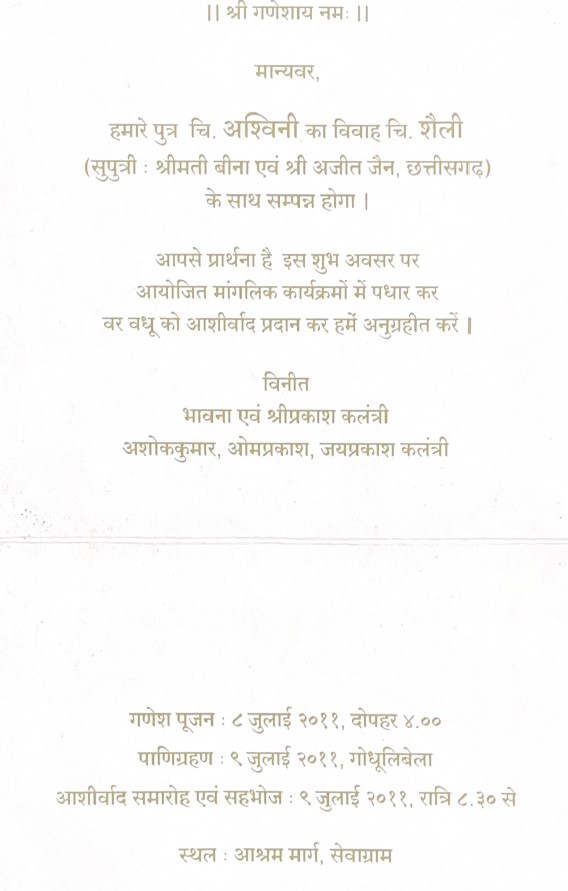
I have always had an allergy to what I call “wedding English”—that ornate language of “benign presence” and “cordial solicitations” that sounds as if borrowed from a government circular. This was not a printed card anyway, only an email to old friends, and I wanted it to sound like us: plain, slightly amused, aware of time passing faster than we liked.
One evening I sat at the dining table with my laptop open, typing and deleting, typing and deleting again, trying to find the right beginning. Finally I wrote what felt simplest and truest:
How quickly children grow up—or perhaps it is we parents who grow old faster. The arithmetic, I realised, was unforgiving. Somewhere along the way I had crossed fifty without noticing, and Ashwini, who had once needed pocket money for comic books, was suddenly half his mother’s age and ready to be married.
A few more lines followed.
That sounded less like an announcement and more like a conversation, so I pressed send.
When it came to drafting the wedding invitation email, I turned to my old friend Dr V. K. Gupta, the Allahabad pathologist, and we would talk over the phone, sometimes late into the night, polishing each sentence until it finally sounded like us.
***
We had built our house on Gandhi Ashram Road a year earlier, opposite the old hospital building. In front of it lay four acres of scrub and wild grass. For weeks we entertained the romantic idea of hosting the reception there. Under the dry June sun the ground looked generous and welcoming, a green spread where a thousand chairs might fit comfortably.
Then the first rains came, and the black cotton soil of Sevagram revealed its nature. The surface softened overnight. Shoes sank. A labourer took two steps and disappeared ankle-deep in mud. Walking required negotiation. We stood watching, trousers splashed, and quietly abandoned the plan.
We shifted instead to the large ground behind the Dean’s office. Ironically, we had once lived directly across from it. It was not picturesque, but it was firm. In a Sevagram monsoon, firm ground is a luxury.
***
On 8 July 2011, Shaily’s family—seventy-five strong—arrived from Kunkuri and settled into the Yatri Niwas Wardha opposite the Gandhi Ashram Wardha. Other guests occupied Arogyadham, vacant flats, and the guest house. For two days the colony lost its boundaries. Doors remained open. Someone was always brewing tea. Children ran in and out of unfamiliar houses as though they had lived there for years.
There were no event managers, no headsets, no printed schedules. Instead, there was Parmanand Tapadiya. A chartered accountant by profession, he carried himself with quiet authority and knew half the town by name. He did not assemble a team; he simply mentioned what needed to be done, and people stepped forward.
Doctors, shopkeepers, and businessmen found themselves checking bathrooms, tasting dal, arranging mattresses, and directing guests. No one spoke of “coordination.” They simply worked.
***
Ashwini once suggested that the ceremony be held inside the Ashram grounds. We had to gently refuse. The Ashram’s silence does not sit comfortably with wedding drums. We chose the Yaatri Niwas instead, a modest government guest house a kilometre away.
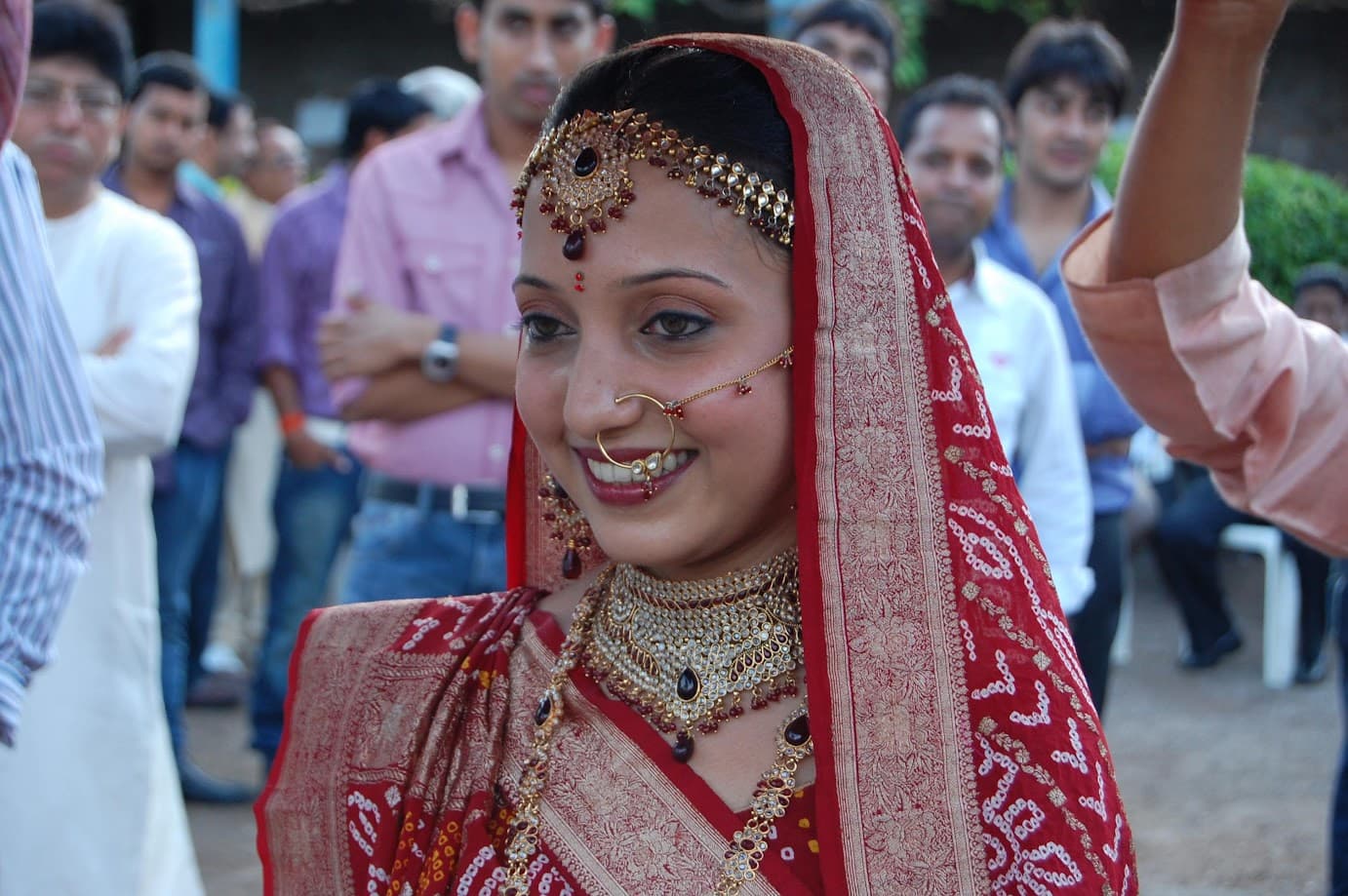
Radiant beginnings: Shaily on her wedding day, July 2011.
The ceremony followed the Wardha method, shaped by Vinoba Bhave and Kaka Kalelkar—simple, unhurried, and free of excess—and it concluded, almost to the minute, in thirty-five quiet minutes. We chose Godhuli Bela, that soft hour when cattle return home and the light turns dusty gold. There were no loudspeakers and no theatrics—only the low murmur of mantras and the faint smell of ghee and smoke. Watching Ashwini and Shaily sit side by side, calm and attentive, I felt the familiar parental astonishment at how quickly childhood folds into adulthood.
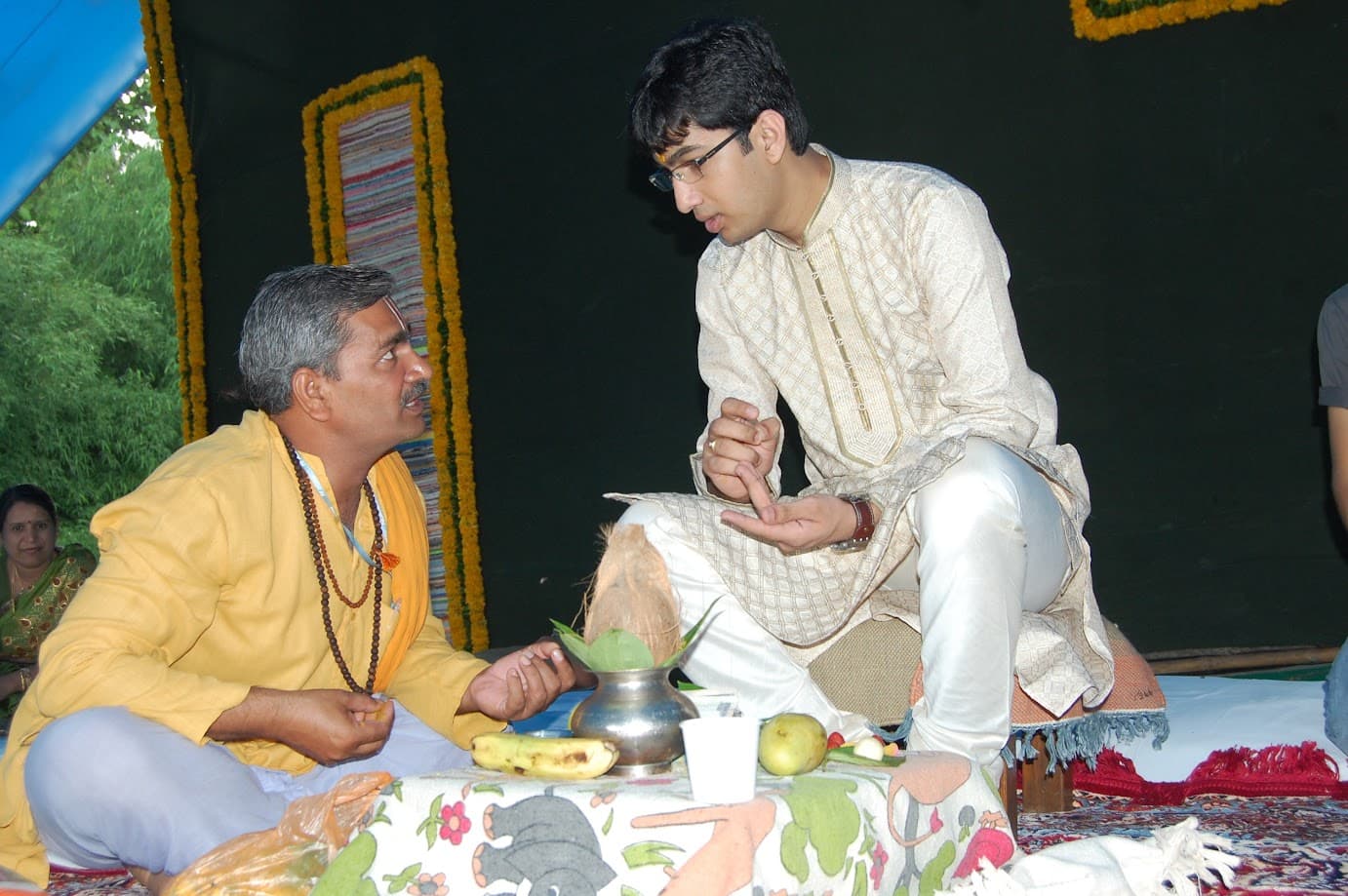
Ceremonial traditions: Ashwini during the wedding festivities, July 2011.
***
The reception began about an hour later. By then the clouds, which had threatened us all week, simply held back, as though granting us a brief reprieve. After weeks of watching the sky with suspicion, we stepped out onto dry ground. Guests kept arriving in a steady stream until the count crossed twelve hundred. They blessed the couple, filled their plates, returned for second helpings, and lingered long after the formalities were over, talking in small circles as dusk slowly gathered.
By the time the final guest left and the colony returned to its usual quiet, the lesson felt obvious. In a place like Sevagram you do not purchase a wedding. You grow it. The weather may misbehave, the soil may sink underfoot, and the guest list may outnumber the chairs, but when friends show up at three in the morning, rebuild a rain-soaked stage, and serve food with their own hands, everything else falls into place. The mud dries. The lights go out. What remains is the memory of having stood together in the rain.
***
Much of the wedding now blurs into a procession of folded hands and smiling faces, but four scenes remain steady in my mind, as clear as if they were lit by a brighter lamp than the rest.
The stage was the first. It became, almost by accident, the heart of the reception. Atul Patel, Amit Gandhi, Anil Kusumbia, Prem Jethwa, Raju Fattepuria, and Raju Verma refused the easy option of hiring a decorator. They wanted something that belonged to Sevagram, something that looked as though it had grown from the soil rather than arrived in a truck. For days they hammered planks, tied gunny cloth, spread plaster of Paris with their palms, and combed it into gentle curves. Gaju Rudrakar arrived with his brushes and added Warli patterns along the surface, and slowly the structure began to resemble a large village hut—simple, earthy, and unmistakably ours.
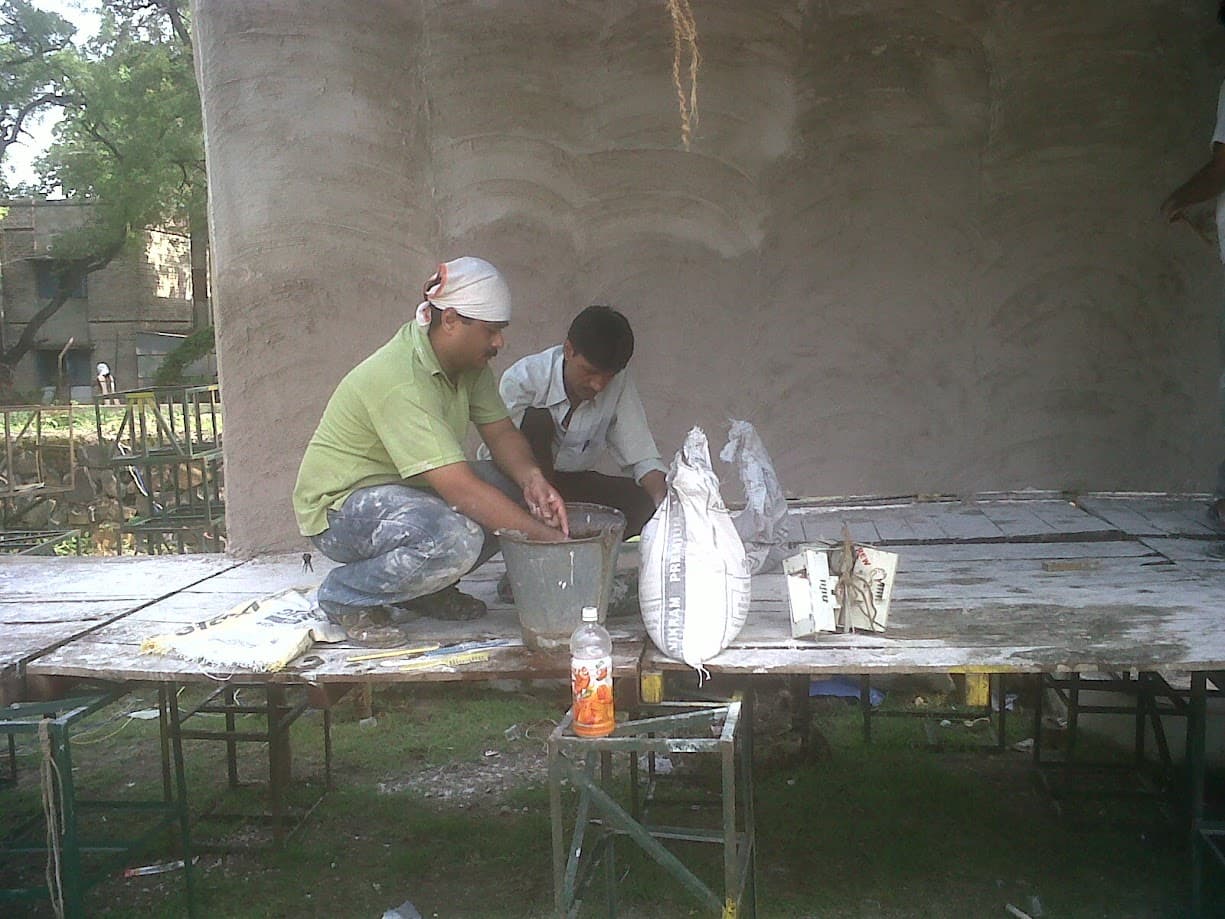
Built with love: Family friends working tirelessly on the reception stage, July 2011.
One evening a sudden downpour washed half the plaster away, reducing the hut to dripping streaks of white. No one complained. They stayed back under torchlight, sleeves rolled up, hands grey with lime and mud, repairing the damage through the night. By morning the stage stood ready again, sturdier for the setback, carrying the quiet pride of the people who had built it themselves.
Hospitality unfolded with the same quiet competence. Shrikant Gandhi and Shyam Kuldhariya moved between guest houses with lists in their pockets, checking bedsheets, buckets, and drinking water as though running a small hotel. At the Yatri Niwas Wardha, Pradeep Bajaj and Om Jogani were everywhere at once—guiding families to rooms, arranging extra mattresses, finding tea for those who had travelled all night. At three in the morning, when most of us were asleep, Ajay Rathi and Vishal Rathi stood at the Wardha railway station, waiting for late trains and greeting half-awake relatives with the reassurance of familiar faces, so that no one arrived feeling like a stranger.
Food came next, and with it the wisdom that an Indian wedding is remembered less for its speeches than for its dal. P. L. Tapadiya brought in Mr Tolaram, who understood this truth instinctively. From dawn the fires were lit and the large vessels rarely empty. Volunteers tasted, adjusted salt, and stirred again. The meals were generous and comforting—food that invited second helpings and long conversations rather than photographs. No experiments, no theatrics, just the steady pleasure of a community eating together.
Cleanliness, though less visible, held everything together. Akhilesh Sinhal and Rupesh Sinhal quietly took charge, moving about with mops, buckets, and an endless supply of water. In the middle of the monsoon, with hundreds of muddy feet crossing the grounds, they kept the place orderly and dignified. Guests rarely noticed their work, which was precisely the point.
Looking back, these tasks—building, hosting, cooking, cleaning—seem modest on paper. Yet it was these very acts, carried out without fuss by people who considered the wedding their own, that held the celebration upright.
***
The Hands That Carried the Wedding
At the centre of everything stood Shri Parmanand Tapdiya, quietly holding the threads together and making sure nothing unravelled.
At the Yaatri Niwas and the guest houses, Pradeep Bajaj, Om Jogani, Harish Kachliya, Sunil Kela, Sanjay Taori, Shrikant Gandhi, Shyam Kuldhariya, Sunil Patel, Ravindra Rathi, Vijai Kharangana Rathi, Kamal Sinhal, Bharat Somani, Gopal Taori, and Kishore Fattepuria moved from room to room, arranging beds, water, and tea, receiving each arrival as though welcoming family home.
In the kitchen, Nandkishore Bhutada, Bablu Chaube, Ashok Goyanka, Dilip Jajodia, Gopi Jajodia, Harish Mudia, and Shyamsundar “Pappu” Rathi watched over the bhojan, while Ramprasadji Gautam guarded the stores and Bharat Doshi ensured breakfast appeared on time, every time.
The stage took shape under the hands of Rajendra Fattepuria, Amitkumar Gandhi, Prem Jethwa, Anil Kusumbia, Atul Patel, Rajabhau Umate, and Raju Verma, who built it plank by plank until it felt less like a structure and more like a part of Sevagram itself.
During the reception, Sunil Chandana, Shyam Taori, Bhogibhai Gorsia, Gauri Tibdewal, Ulhas Jajoo, Suhas Jajoo, Yogendra Fattepuria, and Pappu Taori kept the flow steady, guiding guests, solving small crises, and making the evening feel effortless.
The rituals were conducted with care by Damodar Darak for the pooja, Vijay Mohta for Ganesh, and Sushil Vyas for the baraat, their voices carrying the ceremony forward without haste.
And at the margins, where the hardest work often hides, Ajay Rathi and Vishal Rathi waited at the station for late-night arrivals, Mahesh Mokalkar, Vinod Sinhal, and Asif Bhai kept the vehicles moving, while Akhilesh Sinhal and Rupesh Sinhal quietly kept the grounds clean, so the celebration could proceed with dignity.
The Lesson of the Mud
By the time the last guest departed and the heavy Wardha silence returned to the colony, I was struck by a simple realization. A wedding in a place like Sevagram is not an event you buy; it is an event you earn.
If anyone asks me what I learnt from that monsoon wedding in 2011, I give the simplest answer: the weather is unpredictable, the soil is stubborn, and the guest list always grows beyond the capacity of the chairs. But when fifty-four friends show up in full strength—to greet guests at 3:00 AM, to rebuild a rain-washed stage, and to serve food with their own hands—everything else becomes manageable. In the end, the mud dries, the clouds part, and what remains is not the exhaustion, but the profound, shared satisfaction of a community that knows how to stand together in the rain.
.