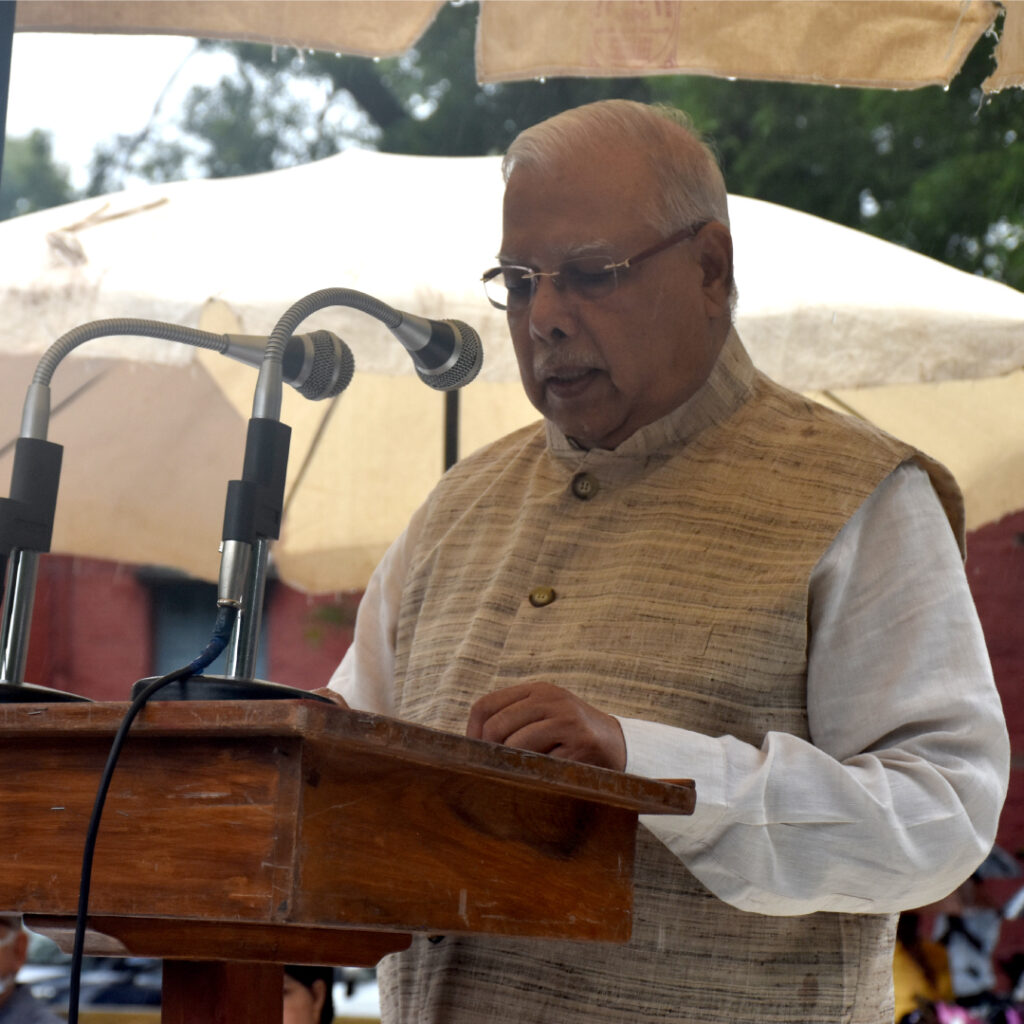
When Dhirubhai Mehta passed away, a heavy hush settled over Sevagram. For nearly a quarter of a century, his voice — booming, teasing, impulsively decisive — had been the soundtrack of the administrative corridors. Suddenly that rhythm was gone. The institute needed a hand that could steady the ship without requiring a spectacle. The mantle fell, almost by gravitational pull, on Mr. Parmanand Tapdiya.
To the casual observer, Tapdiya is the quintessential Chartered Accountant who climbed the Kasturba Health Society ladder the old-fashioned way: rung by rung, from member to trustee, to Vice-President, and finally President. A man of numbers, meticulous, cautious, and deliberate. That description is accurate as far as it goes. It does not go far enough.
***
The Man Who Called My Father Mamaji
To me, the professional title is secondary to a much older, more personal history. He is the man who called my father Mamaji. That single word contains half a century of shared struggle and unspoken debt. Our bond was not forged in committee rooms or over boardroom minutes. It was built on a foundation of gratitude that has remained unshaken since the days when my father mentored him.
In a world where people repay debts with flowery speeches, Tapdiya chose the harder currency of constancy. Since 1986, he has filed my income tax returns every single year — quietly, efficiently, and with a stubborn refusal to accept a single paisa. It is a small act on paper. In the context of a life, it is not small at all. Whether it was my daughter’s wedding or my departure for Berkeley, he was always somewhere in the background — not demanding the spotlight, but ensuring the stage did not collapse. In Sevagram, such loyalty is rarer than brilliance. Brilliance merely shines. Loyalty sustains.
***
What a CA Brings to a Hospital
I have worked in medicine long enough to know that the most dangerous threat to a public hospital is rarely clinical. It is financial. A missed payment stalls a project. A delayed tender creates a drug shortage. A casual signature triggers an audit query that haunts an institution for years. The hospital that runs out of money cannot run at all — no matter how skilled its surgeons or how dedicated its nurses.
This is where Tapdiya’s particular discipline matters. He treats institutional finances the way a good clinician treats a patient: with close attention, early intervention, and a healthy suspicion of assumptions. Under his watch, the accounts are not merely kept — they are interrogated. He understands that in a thousand-bed teaching hospital serving one of the poorest districts in Maharashtra, the difference between a balanced ledger and a deficit is often the difference between a ward that functions and a ward that does not.
He moved beyond the balance sheets during Dhirubhai’s fading years, taking on the gritty labour of construction oversight, procurement, and the endless negotiations required to keep a large institution from stalling. These are unglamorous tasks. They require patience, attention to detail, and the willingness to sit through meetings that produce nothing visible. Tapdiya does them without complaint and without credit.
His approach to financial management reflects a principle I have come to believe deeply: that a pro-poor institution must also be a financially disciplined one. Generosity without solvency is not generosity — it is a postponed crisis. The poor patients who walk miles to reach Kasturba Hospital are not served by noble intentions. They are served by a hospital that has oxygen in its cylinders, drugs in its pharmacy, and staff who have been paid on time.
***
Discipline in the Time of AIIMS
Tapdiya has inherited a storm that would have exhausted his predecessors. The loss of institutional autonomy after NEET and the disappearance of the staff quota have fundamentally altered the Gandhian DNA of our admissions. Simultaneously, the shadow of AIIMS Nagpur — less than an hour away — has changed the local medical map forever. Faculty retention has become a battle. The new generation of doctors often prioritises urban postings and specialisation over the slow, patient art of rural bedside medicine.
His leadership style is a deliberate departure from the giants who preceded him. Dr. Sushila Nayar led with a terrifying moral authority. Dhirubhai led with a Mumbaikar’s instinct and theatrical generosity. Tapdiya leads with dry methodical discipline. He does not trade in slogans or poetry. He calls a spade a spade, sometimes with a bluntness that can feel abrasive to those accustomed to softer diplomacy.
In a storm, however, you do not need a poet. You need a firm hand on the tiller.
***
The Mike Brearley of Sevagram
The question whispered in the corridors is whether a man of numbers can steer an institution of ideals. I find myself leaning toward optimism.
Tapdiya reminds me of Mike Brearley — the England cricket captain who was not the most flamboyant batsman but who read the game with a clinical intelligence that transformed an ordinary side into a formidable one. His value was never in the scorebook. It was in the dressing room, in the field placements, in the quiet conversation with a bowler who had lost his rhythm. MGIMS does not need theatrics right now. It needs clarity, financial prudence, and the discipline to remain pro-poor without becoming professionally obsolete.
Watching him lead feels less like a corporate succession and more like the next page of a family chronicle — written in quieter ink, but with a remarkably steady hand.
The balance sheet of Sevagram, for the moment, rests in safe custody.