The Headmaster’s Watch
History is often told in decades, but sometimes the essence of an entire institution must be distilled into minutes. On 27 February 2018 — a Sunday, the kind of bright Vidarbha morning that makes you believe anything is possible — Mr. M. Venkaiah Naidu, the Vice-President of India, arrived in Sevagram to inaugurate our new operating theatre complex.
The ink was still wet on our Kayakalp citation. Four days earlier, Dr. B.S. Garg and I had stood in a grand hall in New Delhi and received an award that ranked MGIMS fourth in the country for cleanliness — behind only AIIMS Delhi, PGIMER Chandigarh, and JIPMER Puducherry. The corridors of Sevagram still carried that quiet pride. And now the Vice-President himself had come.
My task was straightforward, or so I had believed: stand before him, narrate the saga of MGIMS, and tell the story of a fifty-year journey that began with Gandhi’s blessing and a handful of idealistic doctors in 1969. I had spent three evenings preparing. Thirty slides. Twenty minutes. A five-decade tapestry of service, carefully arranged.
I arrived at the venue early, ran through my opening lines in my head, and waited.
***
The Rebuke
When Mr. Naidu walked in, the room rearranged itself around him. He was a compact, purposeful man, and he moved the way senior politicians do — as if time itself owed him a debt and was perpetually failing to repay it. He settled into his chair, looked around the room with the quick assessment of a man who has seen a thousand such occasions, and then fixed his gaze on me.
I stepped toward the podium.
He raised a hand.
“Move fast,” he said. His voice was not unkind, but it left no room for negotiation. “Don’t waste time. I already know the background of your institute.”
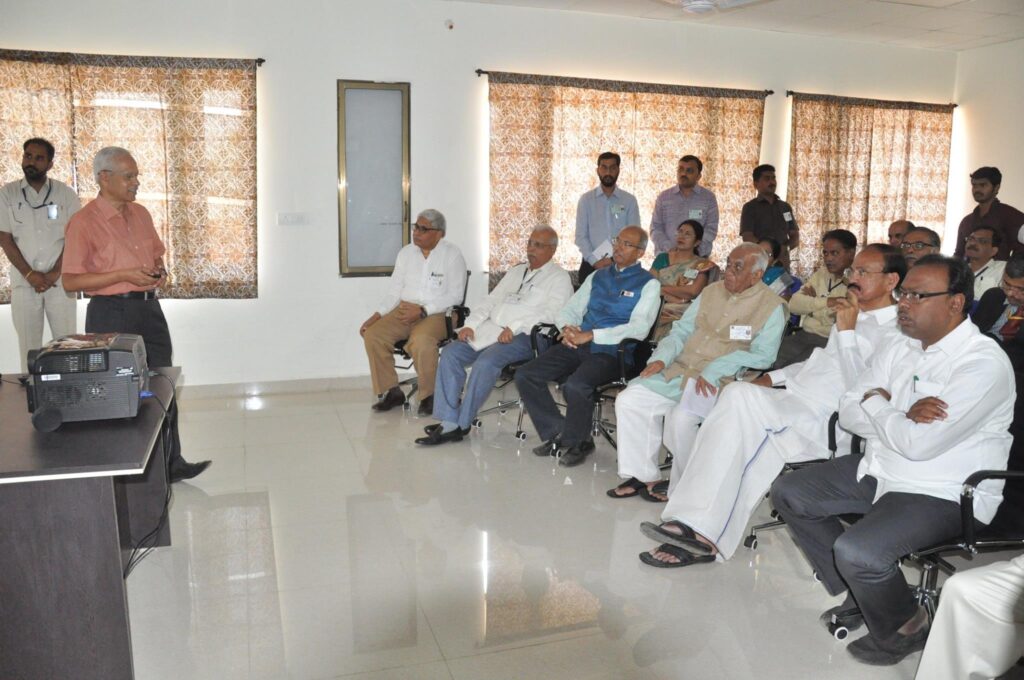
27 February 2018 — seven minutes to present fifty years of MGIMS. Mr. Venkaiah Naidu is in the front row, teal jacket. The projector is running. The clock is ticking.
He glanced at his watch. Then back at me.
The room went very quiet. Somewhere behind me, I heard someone shift in a chair.
Forty years ago — as a young resident, as a nervous faculty member presenting at a departmental meeting — that look would have undone me entirely. My mouth would have gone dry, my carefully rehearsed sentences would have dissolved, and I would have stood there with thirty slides and nothing to say. But at sixty-two, something had changed. I had stood at enough bedsides, delivered enough difficult news, and navigated enough impossible administrative situations to know that panic is simply adrenaline without a plan.
I took a breath. I made a quick mental calculation.
Twenty minutes compressed into seven. Thirty slides. That is roughly one slide every fourteen seconds.
I had prepared for a leisurely fifty-over cricket match. The Vice-President had just invoked the Duckworth-Lewis method. There was nothing to do but bat.
***
The Seven-Minute Sprint
I clicked to the first slide and began.
I did not linger. I did not explain. I let the images carry the weight of words I did not have time to speak. The dusty rural clinics of the 1970s, when MGIMS was still finding its feet. The first ICCU, assembled with limited money and unlimited determination. The faces of farmers who had walked into Kasturba Hospital barely alive and walked out with new hearts. The Kayakalp plaque, fourth in India. Each image held a story that would have taken ten minutes to tell properly. I gave each one fifteen seconds and trusted that a picture, as someone once observed, is worth the words you do not say.
The room was attentive. I could feel it — that particular quality of silence that means people are listening rather than merely waiting for you to finish.
Mr. Naidu leaned forward slightly on slide eleven. I noted it without breaking stride.
On slide nineteen — the one showing our dialysis unit, 600 patients a month, most of them covered by government insurance — I saw him nod. Once. Slowly.
I clicked through the final slide and looked at my wristwatch.
Seven minutes flat.
I stepped back from the podium. The room exhaled.
“Good,” said Mr. Naidu. Just the one word. But in the economy of a Vice-President’s vocabulary, it carried the weight of a paragraph.
***
The Run
What followed was undignified and entirely necessary.
Mr. Naidu was immediately surrounded by his security detail and whisked toward the new operating theatre complex for the formal inauguration. Protocol required that I be at the plaque before him — to receive him, to stand beside him, to speak if asked.
The problem was that between me and the plaque stood a hundred metres of corridor, a procession of television cameras, a cluster of journalists walking backwards while pointing lenses at the Vice-President, and a small battalion of local politicians who had been waiting since morning for their moment in frame and were not inclined to move for anyone.
I did not walk. I moved — sideways, forward, occasionally diagonal — through gaps that appeared and closed in the same second. I excused myself past a camera tripod. I squeezed between two MLAs who were deep in conversation and appeared not to notice me at all. At one point I found myself briefly trapped behind a television correspondent who was delivering a piece to camera with the solemnity of a man reporting from a war zone.
I arrived at the plaque, straightened my jacket, and caught my breath in the three seconds before Mr. Naidu turned the corner.
He arrived. He looked at the plaque. He looked at me — with, I thought, a slight flicker of surprise that I had beaten him there.
He picked up the ceremonial cloth and paused.
“Tell me,” he said, turning to me with the directness of a man who has no patience for prepared answers, “do you have faculty living on campus? Or do you bring them in from Nagpur every morning?”
“Every faculty member lives here, sir,” I said. “In the village. Among the people they serve. Some have been here for thirty years.”
He considered this. “And medicines? Are you prescribing generics?”
“Every day, sir. We fight that battle every single day.”
He nodded. He unveiled the plaque. He said a few words — measured, genuine, the kind of acknowledgment that a large institution might receive with fanfare but that felt, in Sevagram’s quiet courtyard, like something more personal.
And then he was gone, moving briskly toward the auditorium where he would confer the International Gandhi Award for Leprosy on two doctor-researchers who had spent their careers doing exactly what MGIMS had always tried to do: taking medicine to the people who needed it most.
***
The Afterwards
I stood in the courtyard for a moment after the convoy moved on. The cameras had followed the Vice-President. The politicians had followed the cameras. The courtyard was suddenly, briefly, empty.
It had been, I reflected, an unusual morning. I had been rebuked before I began, had compressed fifty years into seven minutes, had run through a gauntlet of television crews, and had answered two questions at a plaque while still catching my breath.
Later that evening, Ulhas Jajoo — who had missed the morning’s drama entirely — called from his home.
“How did it go?” he asked.
“He gave me seven minutes,” I said.
There was a pause on the line. I could almost hear him calculating.
“Seven minutes? For fifty years?”
“Seven minutes. Exactly.”
A longer pause. Then, in the tone he reserves for situations that are simultaneously absurd and entirely typical of Sevagram: “And did you finish?”
“Slide thirty. Seven minutes flat.”
He laughed — the deep, unhurried laugh of a man who has known you long enough to find your predicaments genuinely funny. “Of course you did,” he said. “Of course you did.”
***
I had started the morning fearing I would have to run a gauntlet. What I discovered instead, on a sunny Sunday in Sevagram, was something more useful: that at sixty-two, I still had a good run left in me.