My education began not with a love for books, but with a visceral hatred for school. In the late 1950s, I was enrolled in the Jamnalal Bajaj Bal Mandir—a cluster of huts behind Maganwadi that looked more like a quiet backyard than a temple of learning.
Every morning, a tonga arrived with a clip-clop that sounded to me like a police escort. Other children climbed in with the resignation of the doomed; I treated it like a moving jail. I cried, I protested, and on two memorable occasions, I bit the poor tonga-wallah. Whatever the saintly Mirabai Mundra and Yamunatai Jajoo tried to teach me has long since evaporated. What remains is the memory of the art of refusal.
By age five, I was sent to the Nagar Parishad school. We went barefoot, hauling heavy cotton bags like laborers transporting grain. Inside, there were no benches. We sat on a thin mat—a dari—in neat, cramped rows where our entire world began and ended at the edge of that woven strip. Our teacher, Mr. Champalal Chaubey, ruled from a desk that served as his throne. When the room grew too cheerful, he would crack his palm against the wood, a sound that brought an immediate, clinical silence. On hot afternoons, he would stretch his legs across that same desk for a nap, leaving us to scratch at our slates while the King slept.
I was twelve before I finally mastered the bicycle—a sleek, shining creature I had previously only admired from a distance. My salvation was Sunil Pawar, a neighbor and classmate at Craddock High School. Sunil had mastered the “small push.” He would hold the seat firmly as I wobbled like a newborn calf, running beside me until, without warning, he let go.
For a few seconds, I wouldn’t realize I was moving on my own. The road would slide under me, the wind would rise, and I would feel a freedom that was both thrilling and terrifying. My landings were less poetic. I had a talent for collapsing in a heap with the machine, a scene Sunil watched with the tolerant amusement of an elder brother. Eventually, the bicycle became a habit. By medical college, I rode with the reckless confidence of the young and unhurt, taking corners with no hands on the bars, believing I was the king of Wardha’s quiet streets.
Sunil’s last decision was a “small push” of a different kind. Like his father and wife before him, he donated his body to the Anatomy department at Sevagram. In the same halls where I once learned the map of the human body, Sunil offered himself as the final lesson. He held the seat steady for the next generation of doctors, and then, at the right moment, he let go.
***
The Final Lesson of Sunil Pawar
Years have a way of reversing our roles. I became a physician; Sunil returned to the earth, managing the family farm. Life was not gentle with him. He lost his son to a spinal tumour and his wife to a brain tumour — blows that leave a man quiet, even when he continues to smile.
In 2021, our childhood arrangement turned itself around. The boy who once held my bicycle seat now lay in a hospital bed, and I became his doctor. He was battling laryngeal cancer. A tracheostomy had taken his voice, but we spoke through signs and the steady understanding of a lifetime.
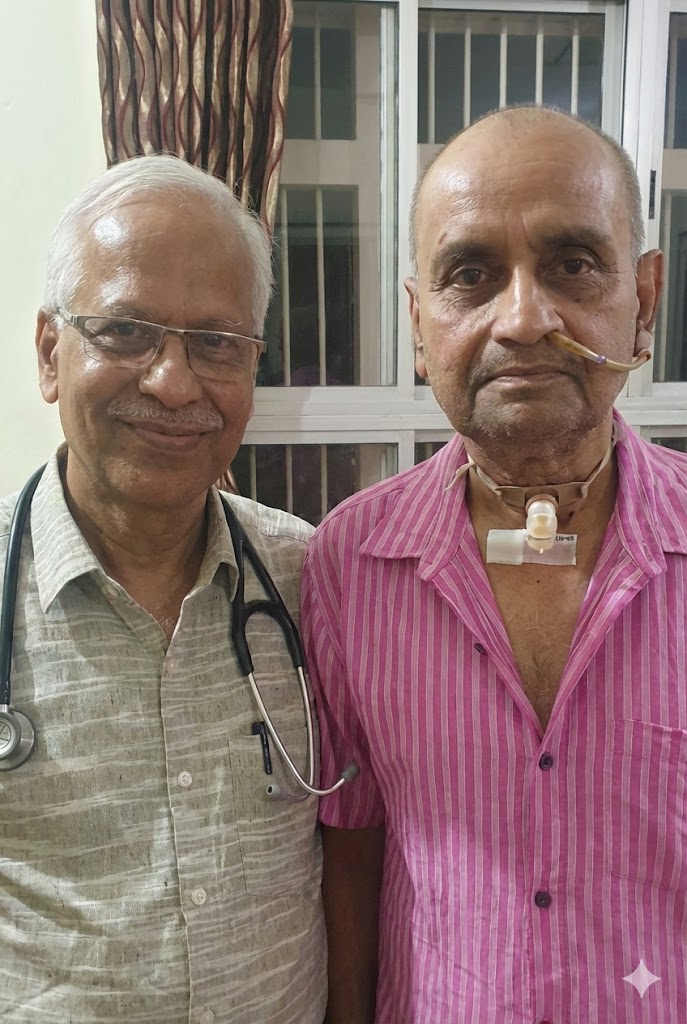
He did receive some radiation and a few cycles of chemotherapy, but decided against interventions that made his life difficult. He bought a new car, drove a thousand kilometres across Maharashtra, and was always smiling — even though he knew his days were numbered. I would often go to his home in Wardha and spend time with him. Having lost his voice, he communicated in sign language. I saw him the day before he passed away and could not meet his eyes. The next morning, the news arrived that he had died in the early hours.
Sunil had already directed that his body be donated to the anatomy department of our medical college, where students could learn human anatomy. He was not the first from his family to make this choice — his wife, who had died of a brain tumour fifteen years earlier, and his father, who had died of old age, had wished the same. When we took Sunil’s body to the anatomy department, and it was filled with formalin and returned to its place among the preserved, a tinge of sadness enveloped me.
A part of the childhood memory was deleted.