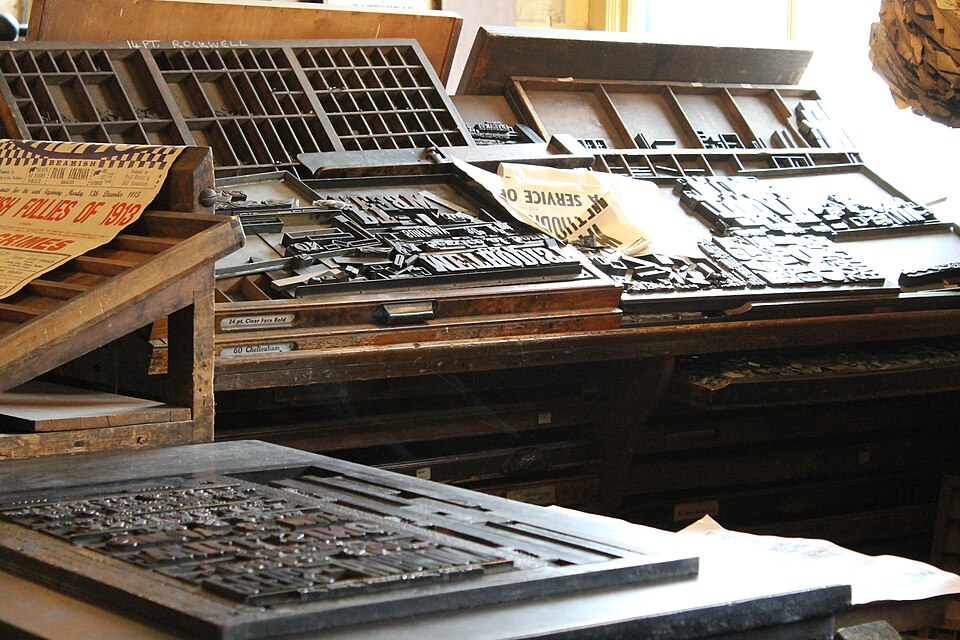
My first tryst with printing was in 1986, when I began helping edit the MFC Bulletin. The articles arrived by post — most handwritten in varying degrees of legibility, a few badly typed on manual typewriters with faded ribbons, the letters uneven, the margins ignored. My job was to collect them, mark them up, and take them personally to Samyayog Press in Wardha, near Rajkala Talkies, on my scooter.
Shri Tukaram Chaudhari managed the press. He wore a spotless Gandhi shirt and dhoti, a Gandhi cap placed squarely on his head, and carried himself with the quiet discipline of a man who believed that a clean uniform and a clean proof sheet were equally important. He was unhurried, courteous, and entirely unimpressed by titles. A Professor of Medicine from the hospital up the road was, to him, simply another person who needed a job done correctly.
He had a small team of boys, each one trained in a specific task. One handled the type-setting — picking individual metal letters from the shallow wooden trays and assembling them by hand into words and lines. Another managed the inking — rolling a brayer evenly across the assembled type to coat every raised surface with a thin film of black ink. A third operated the press itself, feeding sheets of paper with a careful precision that came from doing it a thousand times. A fourth handled the proofing — peeling back each freshly printed sheet, holding it to the light, looking for the letter that had shifted, the line that had slipped, the word that had come out faint because the ink had run thin. Together they moved through the room with the practised ease of a surgical team — each knowing his role, each trusting the others to do theirs.
Watching him was like watching a man knit. There was the same repetitive rhythm, the same unhurried confidence, the same quiet that comes from doing one thing so many times it no longer requires thought.
When a line was complete, he transferred it to a flat metal tray, building the page column by column. Thin metal strips between the lines controlled the spacing. There were no fonts to click, no sizes to select from a menu. Every choice was physical — a different tray for a different typeface, fetched and returned by hand. When the page was assembled, it was locked into a frame and placed on the press: a heavy cast-iron machine that had probably been printing things since before Independence. Ink was rolled across the raised type. A sheet of paper was laid over it. A lever came down. The sheet was peeled back and held to the light.
This was the proof. Errors at this stage were painful. A wrong letter meant finding the right metal slug among hundreds, removing the wrong one with a pointed tool, substituting it. There was no undo button.
Often it would take four hours to set a single page. I would sit on a wooden stool beside the compositor, marking corrections on the proof, drinking tea brought in a glass from the stall outside. The ceiling fan turned slowly overhead. The press thudded with a steady, industrial heartbeat. Somewhere outside, Wardha went about its afternoon.
Then computers arrived. The software was PageMaker — a desktop publishing programme that let you design an entire page on screen, adjust the spacing with a keystroke, and send a clean file to the press. What had taken four hours now took forty minutes.
I do not miss the old way. But I understood, after those evenings at Samyayog Press, that every word on a printed page was once placed there by a person — one letter at a time. It made me a more careful editor. Perhaps it made me a more careful physician too. The principle is the same: small errors, in printing as in medicine, have a way of becoming large ones.