On January 3, 2001, a silence fell over Sevagram. Dr. Sushila Nayar — our Badi Behenji — was gone.
She had passed away in Prerna Kutir, a residence stubbornly modest for a woman of her stature. Visitors did not sit on sofas; they sat on a thick cotton mattress covered with stark white khadi sheets. On that mattress, the hierarchy of India dissolved. A Union Minister would sit cross-legged beside a ward attendant, both held in the same steady gaze. To the nation, she was Mahatma Gandhi’s physician and a freedom fighter. To us, she was simply the gravitational force that kept MGIMS from floating away.
With her passing, the baton moved to Mr. Dhirubhai Mehta. He took charge quietly, aware of the giant shadow he was stepping into.
***
The Phone Call
By August 2001, I was finally exhaling. For six months I had been obsessed with renovating the Medicine ICU — a project that had turned me into what I jokingly called an “intellectual decorator.” Alongside Dr. Rajnish Joshi and a nocturnal architect named Anil Pandit — who prowled the construction debris at midnight with a cheek full of paan — we had turned a pile of rubble into a functioning place of healing.
Then the phone rang. It was Dhirubhai.
“SP,” he said, using the initials that only close friends used. “We need to bring out a book. A tribute to Behenji. I want you to edit it.”
A surge of honour. Then a cold wave of alarm.
“When is the release?”
“Her first death anniversary. January 3, 2002.”
I did the arithmetic. Four months. In the Sevagram of the early 2000s — where communication still moved at the speed of the post — four months was effectively yesterday. The intellectual decorator hung up his hard hat and picked up a red pen.
***
The Team
I knew my limitations. I needed a partner who handled the English language with surgical precision. I called Dr. Prabha Desikan, Class of 1984. Prabha had Sevagram in her marrow — her father was the legendary leprosy researcher Dr. K.V. Desikan. She possessed an editor’s eye: sharp, patient, and entirely unsentimental.
We were joined by Dr. Rajnish Joshi and Dr. Ashish Goel, both from the MGIMS classes of 1992 and 1993, then in the middle of their MD residency in the department. Today both are Professors of Medicine — Rajnish at AIIMS Bhopal, where until recently he also headed the department, and Ashish at AIMS Chandigarh, where he currently heads it.
They were a perfect counterbalance. Rajnish possessed a restless, fertile mind—quick to innovate and uniquely capable of wrestling fleeting ideas into finished realities. Ashish, on the other hand, wore the quiet, measured look of a man who weighs his words. He anchored the project with exactly what it required: precise writing, meticulous proofing, and an intuitive sense of how text should rest on the eye. We would need all of it. Together, we faced a staggering mandate: forty-five contributors, a three-month deadline, and the grueling, everyday demands of our hospital work—the packed OPDs, the wards, the ICUs, and the unpredictable rush of medical emergencies. And, lest I forget, Rajnish and Ashish were simultaneously writing their own MD theses.
Yet, despite the exhaustion of the wards and the weight of their theses, we were driven by a singular vision. We wanted the volume to be what Prabha Deikan and I called in the introduction a “prism of affection.” To build it, we reached out to MGIMS faculty, administrators, politicians, Gandhian scholars, social workers, and alumni, leaving the content entirely to the contributors. We weren’t trying to create a perfect, saintly portrait that hid her flaws. We were after something much more difficult: a small, honest tribute to a woman who refused to give up, told through the raw and real stories of the people whose lives she had changed.
***
The Printer’s Lifeline
For the printing, I turned to Vinod Sinhal. He was thirty-five then, a man quietly carving out his own path. His father ran R.D. Sinhal Stores, a well-known shop in Wardha Market that sold everything from stationery to guns and bullets—a combination only small-town India could produce without irony. The elder Sinhal was a man of firm principles; if a child returned too soon for more pencils, he would conclude they had been careless and refuse to sell them any. Schoolchildren approached his counter with the same caution they reserved for difficult teachers.
Vinod, however, had moved out from under that stern shadow. By 1996, he had set up his own small press in the industrial area, four kilometers from the college. He had never produced a book before, and when I approached him, he accepted the commission with a visible, nervous hesitation. What he could not have known then was that this project would go on to define the rest of his professional life.
Since Vinod was new to books, we had to assemble a makeshift team across two cities. We worked with Prashant Thakre, who ran a small typesetting center in Wardha, but for the heavy lifting, we had to look toward Nagpur. The project was a massive technical undertaking for its time. We had piles of black-and-white images from the 1940s that required high-resolution scanning—a luxury in 2001. We took them to a specialist near the Gandhi statue in the Mahal area of Nagpur, paying nearly ₹18,000 for scanning alone.
For the visual design, we found Vijay Farkase. He was a talented man who had designed the iconic Haldiram’s snack pouches but, like the rest of us, had never worked on a book. We were all learning on the fly, a team of amateurs fueled by enthusiasm.
This inexperience led to one serious setback: after the first few copies were printed, we discovered a layout error. We had to reprint the entire run. It was a costly, demoralizing blow, but in the spirit of the woman we were writing about, we absorbed the loss and moved on.
***
The Shirt on the Scanner
As the deadline approached, the cover remained our biggest hurdle. The sketches looked amateur, and the photographs felt generic. We wanted something that was unmistakably “Behenji”—plain, firm, and without ornament.
We were sitting in my office, staring at a succession of failed proofs, when Rajnish Joshi suddenly pointed at my chest.
“Sir,” he said. “Why don’t we use that texture?”
I was wearing a yellow khadi shirt. In Sevagram, khadi was the code. I had made my own compromise with the institute’s dress culture: I wore crisp khadi shirts rather than trousers, which usually crumple so badly by late afternoon that you end up looking like an unmade bed.
“The fabric,” Rajnish insisted. “That’s her.”
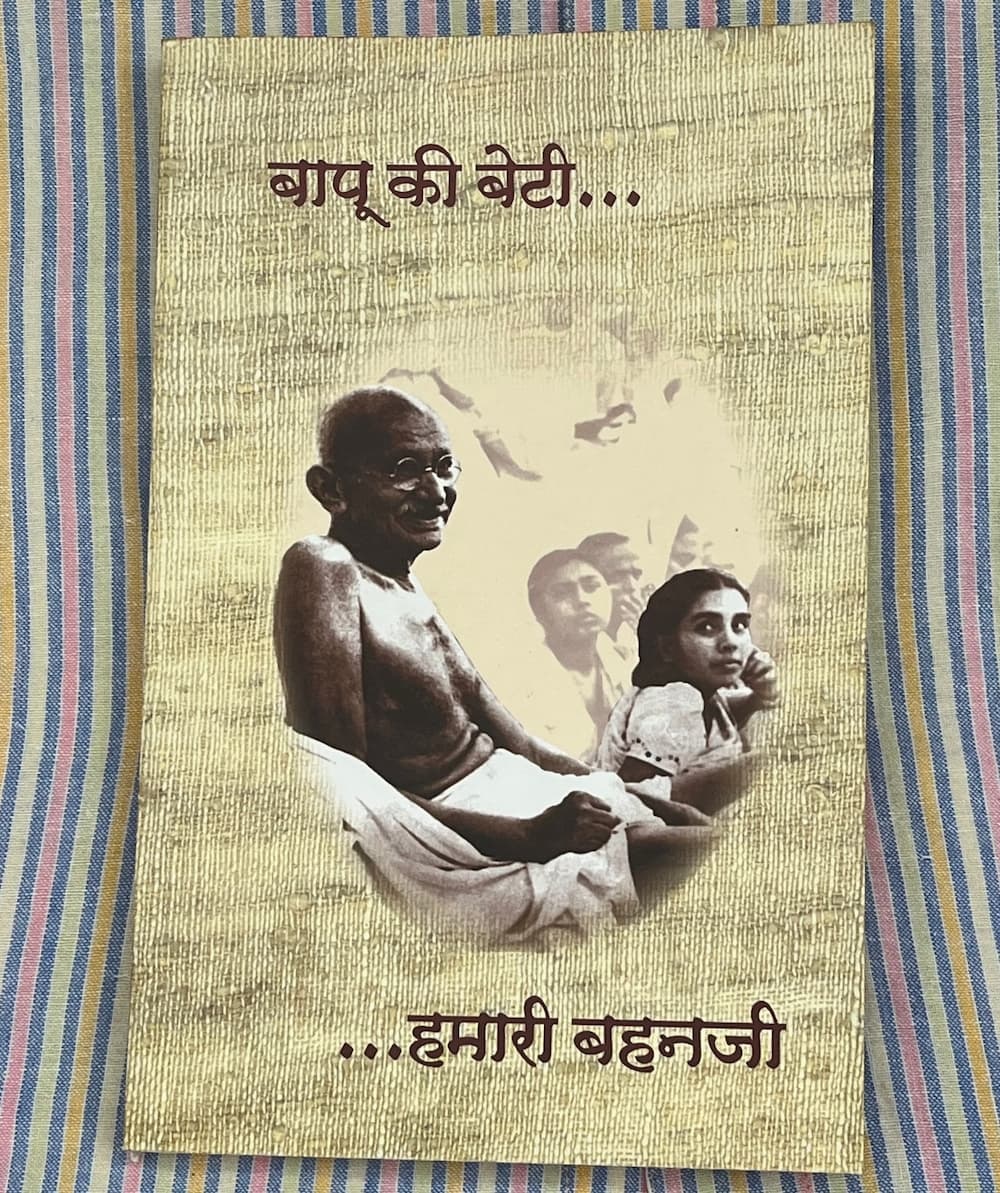
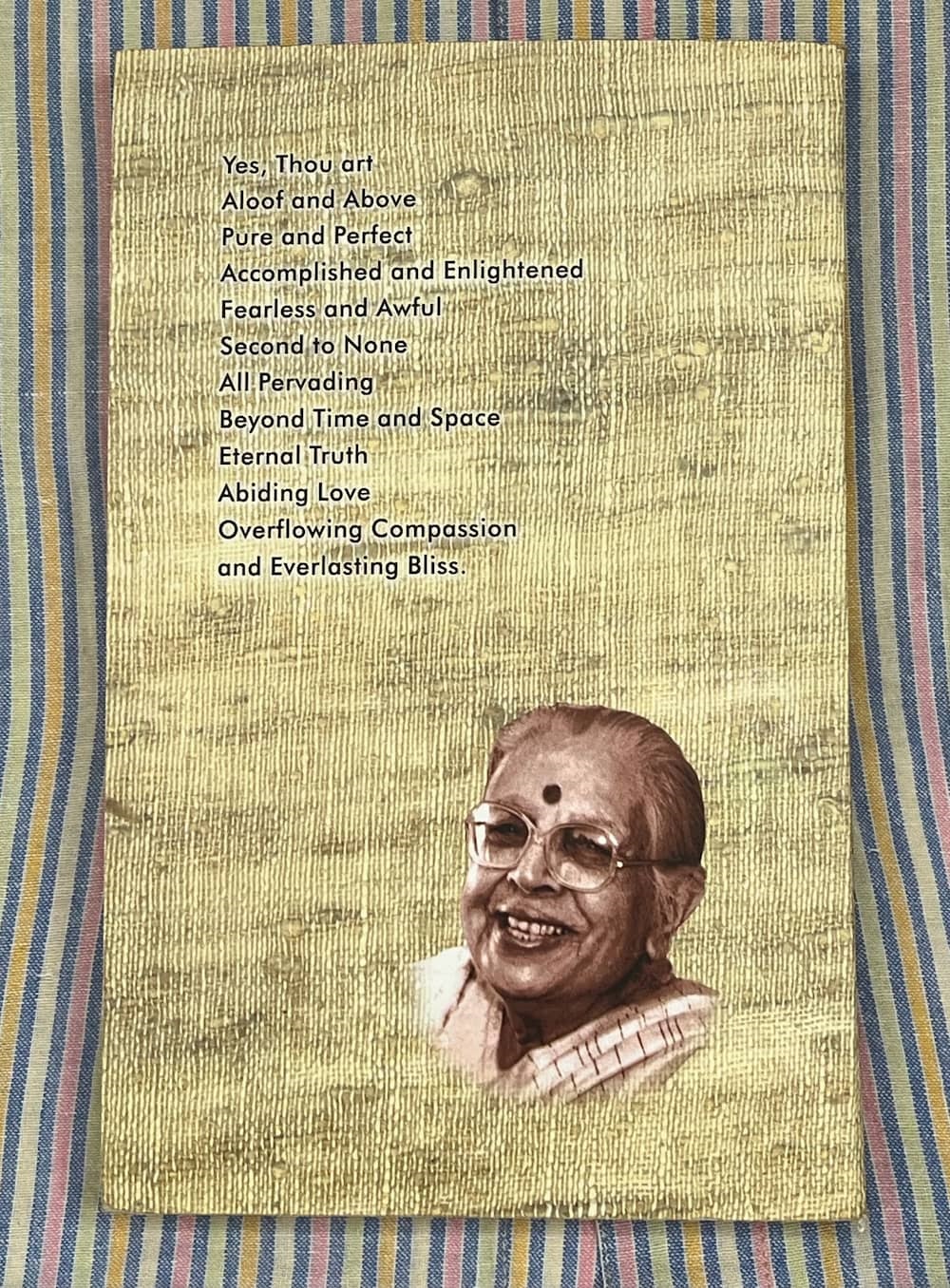
We took the shirt off my back right then and there and placed it on the glass bed of a flatbed scanner. The machine whirred, capturing the rough, uneven weave of the hand-spun cloth. That scan became the soul of the cover. Over that yellow texture, we superimposed a sepia photograph of Behenji sitting beside Bapu. The title followed naturally: Bapu Ki Beti, Hamari Behenji.
The photographs inside presented their own challenge. We didn’t want the book to look like a modern documentary; we wanted it to feel like a memory. Today, you can achieve this with a simple Instagram filter, but in 2001, it required a kind of darkroom alchemy. We drove to Nagpur yet again to find a specialist who could convert the sharp blacks and whites into warm sepia tones.
We didn’t want the book to look glossy; we wanted it to look timeless. When the first proof finally came off Vinod’s machine, we knew we had achieved it. Gandhi. Behenji. Khadi. Nothing extra.
***
The Steel Behind the Compassion
Tribute books suffer from a predictable disease: they become hagiographies — garlands of sugary praise in which the subject ceases to be human. We were determined to avoid this.
Everyone in Sevagram knew Behenji’s famous temper. It was not the petty irritation of a bureaucrat. It was the terrifying wrath of a matriarch who could not tolerate laziness, excuses, or indifference to patients. We included a detailed interview from the National Medical Journal of India where she spoke in her own unvarnished voice. We ensured the essays we selected reflected both her immense compassion and her steel. A Behenji without her temper would not have been Behenji.
Prabha Desikan worked through the drafts with a disciplinarian’s eye — smoothing language, fussing over margins, obsessing over font sizes and spacing. The invisible details that decide whether a volume looks like a serious work or a rushed souvenir.
***
One Minute of Glory
When the final copy was bound, I took it to Dhirubhai. He held the book in both hands, running his fingers over the cover — perhaps recognising the texture of the ideology he was now sworn to protect. He praised the work at length. Then the practical man surfaced.
“How much did it cost?”
“The printer’s bill is ₹1,40,000.”
He nodded, pulled out his pen, and authorised a payment of ₹1,50,000. It was a gesture of class — his acknowledgment that Vinod Sinhal had gone beyond what was asked.
On January 3, 2002, exactly one year after she left us, the book was released at a ceremony in the open ground behind the Microbiology department. The chief guest was Shri Krishan Kant, the Vice President of India. Security was tight, speeches were long, and the stage was crowded.
I was not on it. I do not recall being invited even to the front row. In the theatre of official functions, the workers are rarely the actors. The flashbulbs popped, the Vice President held up the yellow cover, and the applause moved through the crowd.
It did not matter. Standing at the back, I felt a quiet, private satisfaction that had nothing to do with the stage. I knew the one-minute glory of a public function fades before the car reaches the gate. But the book was real. We had taken the rough weave of a khadi shirt and turned it into a testament. We had preserved the spine of Sevagram.
For Vinod Sinhal, that single project changed everything. He mastered the trade, went on to publish the MGIMS News, police annual reports, and nearly every publication the institute required. A partnership that continues to this day — built, at its beginning, on a nervous young man’s willingness to say yes to something he had never done before.