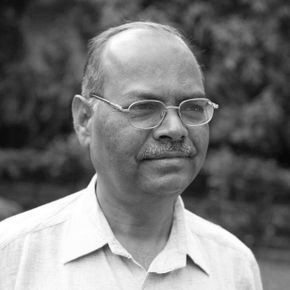
Dr. Kisan Rajaram Patond
Professor & Head of Orthopaedics · Medical Superintendent · Dean · MGIMS Tenure 1988 – Present Born 26 February 1956, Sasti, Akola district Education MBBS, Government Medical College Nagpur (1978)MS Orthopaedics, Government Medical College Nagpur (1983)
Sasti, Akola, and the First Doctor from the Village
Kisan Rajaram Patond was born on February 26, 1956, in Sasti, a village thirty-five kilometres south of Akola. His father was a small farmer with four years of schooling. His mother had no formal education. He completed his primary education in Marathi at Shri S.L. Shinde Vidyalaya in Sarsi, moved to RLT College, Akola, and in 1974 secured admission to Government Medical College, Nagpur.
He is not entirely sure, looking back, why he chose medicine. “I chose science on my own, scored well, applied to medical college, and got in. My parents had no clue about the process or what it meant.” The honest uncertainty of that answer is more revealing than a polished narrative would be — a village boy who applied the same methodical effort to each step that presented itself, without the guidance or the social capital that shaped the choices of those who came from medical families or urban professional households.
He graduated MBBS in 1978, winning the Shri D.V. Bhiwapurkar Prize for top rank in the Final MBBS Examination at Nagpur University. He pursued his MS in Orthopaedics at GMC Nagpur under Dr. N.K. Saxena — whose dissection techniques he would describe decades later with the reverence of someone describing a formative aesthetic experience: “Precise, detailed, like an artist carefully sculpting a masterpiece.” His MS thesis examined how electrical stimulation could accelerate bone healing. He completed the degree in March 1983 and moved progressively through Lecturer and Reader posts at GMC and IGMC Nagpur before Dr. Vikram Marwah’s advice at a conference changed the trajectory.
The Advice, the Forfeited Salary, and the Arrival
Badi Behenji made up her mind within minutes. Dr. Patond had arrived at Prerna Kutir with a letter of recommendation and a solid track record. He was shy and reserved — not the kind of person who could walk into a room and promote himself with confident ease. The conversation was brief. Dr. Sushila Nayar saw what she needed to see and told him she wanted him to join the next day.
He had to serve a month’s notice at IGMC Nagpur or lose a month’s salary. He thought about it briefly, then made a decision uncharacteristic for someone usually cautious: he forfeited the month’s salary, packed his bags, and came to Sevagram. He arrived on February 19, 1988, into a department that had been without a permanent head since Dr. Kush Kumar’s departure the previous year. He was appointed Professor in April 1990 — two years after joining, considerably faster than the government college trajectory would have allowed.
When he arrived, he went through the old departmental records as a way of understanding what he had inherited. Dr. Ahuja’s legacy emerged from those records: the hand clinic and polio clinic, the leprosy surgical clinic at the Gandhi Memorial Leprosy Foundation, the fortnightly outreach to Deoli and Pulgaon, the postgraduate programme launched in 1980. “I couldn’t help but feel inspired,” Dr. Patond said. “I saw the incredible impact Dr. Ahuja had made and felt a surge of motivation to carry the torch forward.”
The Department He Led
His discipline was expressed most visibly in the OPD, which opened at 8 a.m. without exception. He mentored thirty-eight MS students between 1989 and 2016, and twenty-five diploma students. His first postgraduate student, Dr. Sudhir Srivastava, went on to lead the Orthopaedic Surgery department at KEM, Mumbai.
His clinical focus shifted over time toward joint replacement — hip, knee, shoulder, elbow replacements became his primary work, the particular reward of watching patients who had lived with chronic pain and limited mobility walk out restored. “That feeling of making a difference never fades.” His reconstructive surgery expertise in leprosy earned him a fellowship from the National Academy of Medical Sciences of India.
A paper presented at a conference in Hong Kong caught the attention of an expert who would sit years later on an interview panel for a UAE position. The expert remembered the work, remembered the name. “Sometimes,” Dr. Patond reflected, “hard work pays off in ways you least expect.”
The Administration and the Marathi Rule
He served as Medical Superintendent from October 2007 to August 2009, and as Dean from August 2009 to June 2014. He was not the figure who strode into a room and commanded it. He was the figure who arrived, watched, understood, and then acted — decoding bureaucratic language, reading what official documents said and what they did not, understanding the unspoken rules before applying the formal ones.
His one non-negotiable was Marathi. In the OPD, the wards, the operating theatre — conversations happened in Marathi. It was not a statement of regional identity. It was a clinical conviction: doctors working in rural Vidarbha needed to speak the language their patients thought in, not the language their degrees were written in. From August 2009 to 2012, he worked at Gulf Medical College in Ajman, UAE — broadening his perspective and putting his work in front of people he had not previously met.
The Bicycle and the Continuing Presence
His wife retired as headmistress of New English High School in Wardha. Their son Swapnil, a 2002 MGIMS alumnus, completed his MD in Forensic Medicine from the same institution and serves as Professor and Head of Department at Rajendra Gode Medical College, Amravati — the first doctor from Sasti’s son producing the next generation of the medical line.
Dr. Patond continues to see patients, take ward rounds, and perform joint replacements. He cycles through Sevagram each morning with a walking stick in hand to ward off stray dogs — a detail that captures, with the precision of a good X-ray, the quality of a man who combines dedication with pragmatism and has never needed the life to be grander than it is to find it worth living.
He was told by Badi Behenji to come the next day. He forfeited a month’s salary to do so. That was 1988. The village boy who did not know why he chose medicine has spent more than thirty-five years demonstrating that the choice was the right one.
Mentored Students (MD/MS)
Closed intramedullary nailing in displaced fracture shaft of tibia with early weight bearing
Fracture healing under simple external fixator : an experimental study in rabbits
Immunodiagnosis of osteoarticular tuberculosis by ELISA
Clinico radiological evaluation of osteoarthritis of knee intraosseous pressure measurement study in proximal tibial metaphysis
Synovial-fluid analysis in knee disorders
Retrospective study of giant cell tumors of bone
Correlation of arthroscopic clinical diagnosis in disorders of knee joint
Study of post polio residual paralysis around ankle and foot
Fenestration surgery in lumbar disc and canal stenosis
Surgical treatment of flail knee after poliomyelitis
Medial open wedge high tibial osteotomy using bone cement spacer block
Posterior tibial neurovascular decompression in plantar ulcer of leprosy
Ganglion around wrist
Claw hand correction by the lasso procedure in leprosy
Spectrum of orthopedic surgical procedures at MGIMS Sevagram (1990 – 1996)
Thumb deformity correction in leprosy patients
Metaphyseal trabeculectomy of the proximal tibia in early osteoarthritis of the knee
Compartment pressure measurement in closed fractures of leg bones and its correlation and it Z0s correlation with the clinical parameters
Spectrum of congenital Orthopaedics anomalies in the dept. Of Orthopaedics MGIMS Sevagram
Uses of ethylene oxide sterilized allografts in Orthopaedics
Use of pedicle flaps for wound coverage in upper and lower limbs
Arthroscopic lavage in early osteoarthritis of knee joint
Treatment of elbow disorders using sloppy hinge prosthesis
Anterior fusion in Pott’s spine
Closed intramedullary nailing in treatment of displaced diaphyseal fractures of radius and ulna in adults
Acute pyogenic arthritis knee efficacy of open arthrotomy and closed suction irrigation
User of local steroid with 2% xylocaine in tennis elbow
Bipolar arthroplasty in non-infective hip arthritis
Bacteriology of wound contamination in compound fractures at the time of admission
Histopathology of interface tissue retrieved at the time of implant removal
Management of displaced diaphyseal fractures of femur in children with intramedullary kirschner’s wires.
Anterior cervical discectomy and fusion
Intramedullary interlocking in closed tibial fractures
Open door cervical laminoplasty in patients with multilevel cervical spondylotic myeloradiculopathy
Open Door Laminoplasty in Multilevel Cervical Spondylotic Canal Stenosis with Myeloradiculopathy
Primary Plate Fixation of Completely Displaced Midshaft Clavicular Fractures in Active Adults.
Evaluation of intra-articular hyaluronic acid injection in primary osteoarthritis of knee
Bone mineral densitometry in traumatic distal end radius fractures
Epidural steroid injection in managing chronic low back pain
Functional outcome of open reduction and internal fixation of fracture proximal humerus with proximal humerus internal locking osteosynthesis (PHILOS) plate
Epidural steroid in management of chronic low back pain
Epidural steroid in management of chronic low backache
Bone mineral density in traumatic distal end radius fracture
Functional outcome of open reduction and internal fixation of fracture proximal humerus with proximal humeral internal locking osteosynthesis (PHILOS) plate
Open reduction and internal fixation of fracture clavicle treated with pre-contoured clavicle plate
Hospital-based cross-sectional study of osteoporosis in men with proximal femur fracture by peripheral DEXA
Open reduction internal fixation of displaced bicondylar fracture tibia: plating on one side and cannulated CC screws on the other side
Key Milestones
| 1956 | Born, 26 February, Sasti, Akola district — father a small farmer with four years of schooling; mother with none |
| 1974 | Admitted to Government Medical College, Nagpur |
| 1978 | Completed MBBS — Shri D.V. Bhiwapurkar Prize for top rank, Final MBBS, Nagpur University 1979 |
| 1983 | Completed MS Orthopaedics under Dr. N.K. Saxena, GMC Nagpur — thesis on electrical stimulation in bone healing |
| 1983 | Lecturer, GMC Nagpur — then Reader and unit head, IGMC Nagpur |
| 1988 | Met Dr. Sushila Nayar at Prerna Kutir — appointed on the spot; forfeited month’s salary; arrived 19 February |
| 1990 | Promoted Professor, April — two years after joining |
| 2007 | Medical Superintendent, October — until August 2009 |
| 2009 | Dean, August — until June 2014 |
| 2009 | Gulf Medical College, Ajman, UAE — until 2012 |
| 2016 | Fellowship, National Academy of Medical Sciences of India — reconstructive surgery in leprosy |
| 2026 | Continues — ward rounds, OPD, joint replacements, bicycle through Sevagram each morning |