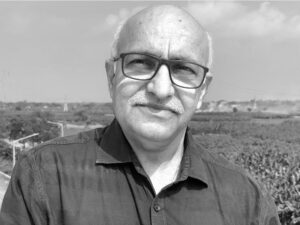
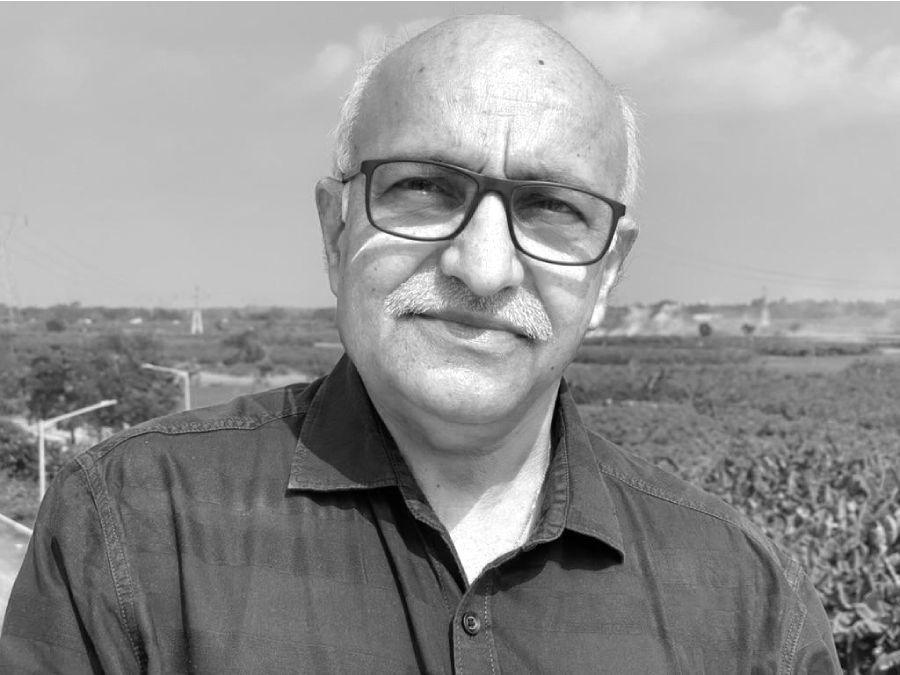
Professor & Head of Physiology · Twenty-Six Years at Sevagram · The Man Who Learned Everything He Needed to Know from Street Dogs
He often said, with a particular kind of rueful gratitude, “I am what I am because of those street dogs.”
He meant it literally. During his postgraduate years at King George’s Medical College in Lucknow, his research on the central action of Angiotensin II in dogs had begun with disaster — animal after animal dying under anaesthesia, an expensive imported reagent wasted, a supervising professor waiting for results that were not coming. The failure had driven him across the corridor to the Pharmacology department, where he spent long hours learning drug administration techniques, unearthed a buried head holder and mechanical drill from the department’s dusty stores, designed specialised cannulas, and rebuilt his entire experimental technique from scratch. When he resumed the experiments, his hands were steady, the animals survived, and the research moved forward. The faculty who had quietly doubted the outsider — he was not a KGMC alumnus — saw what he was made of.
That capacity to fail, analyse the failure, and return with improved hands would become the defining characteristic of a career that took him from a village 100 kilometres west of Gorakhpur to the Executive Directorship of AIIMS Kalyani.
Bansgaon to Muzaffarpur: An Ordinary Beginning
Ramji Singh was born in 1957 in Bansgaon, Gorakhpur district, Uttar Pradesh. His father Keshav Prasad Singh began as an assistant development officer and rose to block development officer, and with each posting the family moved — Maharajganj, Saunghat, Menhdawal, Bhatpar Rani — Ramji adapting to new teachers, unfamiliar accents, and different syllabi with every transfer. The disruption that would have defeated some students sharpened him instead. He learned to find his footing quickly.
His father’s plan for him was modest and clear: become a doctor, return to Ballia, run a small private practice. There was nothing wrong with this plan. Ramji followed it without particular resistance, entering Sri Krishna Medical College in Muzaffarpur with the 1974 batch. Bihar’s academic calendar was chaotic in those years — class suspensions, exam postponements, the institutional disorder that had worsened in the Emergency’s aftermath — and what should have taken five years stretched considerably. He completed his MBBS in 1980.
He remembered one examiner from those years with particular warmth: Dr. S.P. Nigam, a distinguished Professor of Medicine from Sevagram, who tested him on a case of mitral stenosis during the First MBBS examinations. Years later, when Ramji joined MGIMS, he met Dr. Nigam again. The circle had closed quietly, as circles in the MGIMS story tend to do.
In June 1979, a few months before his Second MBBS examinations, he married Lalitaji. Their first son arrived in 1981. He was twenty-two, still in medical school, already a husband and father — the kind of domestic responsibility that concentrates a young man’s ambitions.
The Accidental Physiologist
He had intended private practice. A friend filling out postgraduate applications at King George’s Medical College included Ramji’s name on the form, ticking boxes for every subject including physiology and community medicine, unaware of the cutoff marks. Ramji was accepted into the Physiology programme. He reasoned that an MD would improve his prospects. He went.
What happened next surprised him. Under Professor S.D. Nishith, head of the Physiology department at KGMC, he found himself genuinely engaged by research for the first time. The Angiotensin II project had high stakes — ₹5,000 of the department’s research grant spent on Swiss-imported reagent, a significant sum. When the initial experiments failed and the animals died, Nishith did not rescue him from the consequences. Ramji rescued himself: the corridor visits to Pharmacology, the excavated equipment, the redesigned cannulas, the rebuilt technique. The research recovered. He had learned something about himself that private practice in Ballia could not have taught him.
He did not receive a stipend during his postgraduate years — an unusual hardship for a married man with a child. His second son Ashok was born in October 1984. He worked as a demonstrator from September 1983 onward, the modest salary providing basic stability. He completed his MD in 1985, defended his thesis, and began scanning for lecturer posts.
His department head saw the advertisement for a post at MGIMS before Ramji did. He summoned Ramji, dictated the biodata to his secretary, wrote a recommendation letter in his own hand, and told them to airmail it the same day. It was the kind of mentorship that changes careers by acting before the student has organised himself to act.
Arriving in Sevagram
The interview was scheduled for August 4, 1985. It was Ramji’s first journey outside Uttar Pradesh — a 1,000-kilometre trip over twenty-eight hours. He stepped off at Wardha East station to find every cycle rickshaw taken. A man with two Lucknow students saw his predicament and gestured to a space in his rickshaw: “Come along, young man.” Ramji arrived at his hotel opposite the station carried by a stranger’s generosity.
The next morning, he walked onto the MGIMS campus — gravel underfoot, neem-scented air, the distant sound of ashram prayers. In the Physiology department, Dr. K.N. Ingley greeted him. Dr. M.D. Khapre nodded. Dr. Sutikshna Pande and Dr. K.S. Bhat welcomed him with warm smiles. The easy camaraderie of a small department that knew itself well settled his nerves before the interview began.
Dr. Sushila Nayar opened the proceedings: “Dr. Singh, if selected, how soon can you join MGIMS?”
“Immediately, ma’am,” he said without hesitation.
She outlined the code of conduct: khadi, vegetarian diet, the Gandhian ethos that was not merely institutional decoration but daily practice. He listened and agreed. He had not known, arriving at Wardha station the previous evening, that this was the place he would spend the next twenty-six years. He knew it by the time he walked out of the interview room.
He joined in September 1986. He lived at Kabir Niwas for the first two years, moved to Type-2 quarters, then to MLK Colony, and in 2003 built his own house about a mile from the college. The progression from institutional accommodation to owner-built home is one way of measuring how completely a place has become one’s own.
Twenty-Six Years in Physiology
He rose through the department steadily — Lecturer in 1986, Reader in 1991, Associate Professor in 1995, Professor and Head in 1998 — leading it for thirteen years. His teaching earned him the Professor K.P. Puthuraya Best Teacher Award in Physiology in 2008. He did not seek the award; his students and colleagues had made the case for it.
He registered for a PhD under Dr. Ingley in 1988, intending to continue the department’s reproductive physiology research. The subject did not ignite him. He did not complete it. He was honest about this — a man who understood the difference between obligatory academic credential and genuine intellectual engagement, and who chose not to pretend the two were the same. What he did instead was become a PhD guide himself, mentoring Jyoti Jain, Sachin Pawar, Vinod Shende, Amit Kant, and Bharati Mahindrakar through their doctorates. He supervised postgraduate students from 2002 to 2012 — eight in total, from Alka Rawekar to Vikash Udan — and oversaw MD theses in the Surgery department as well, including work by Tapti Saha on post-meal urinary alkaline changes in duodenal ulcer management and by B.S. Bakane on TENS and surgical wound flap survival.
In December 1999, he organised the 45th Annual National Conference of Physiologists and Pharmacologists of India with Dr. S. John Premendran. The conference focused on hypertension in the new millennium. Hosting a national academic conference in a village with limited infrastructure required the same quality of resourcefulness he had first demonstrated in the dog laboratory at KGMC — securing funding from the Department of Science and Technology, the Medical Council of India, and ICMR, drawing on family resources, managing logistics without urban amenity. Nearly 200 delegates attended. The event proved, as the 1994 Anatomy conference and the 1995 Physiology conference had proved before it, that MGIMS could host national-level academic gatherings with a quality of hospitality that delegates remembered long afterward.
From 1998 to 2003, he served as Warden of the Jawaharlal Nehru Boys’ Hostel — a role he handled with a warmth and accessibility that contrasted with the reluctance other faculty had brought to the same position. He was available, kind, genuinely interested in students as people. The bonds he formed as warden persisted for decades, connecting him to alumni across cardiology, oncology, orthopaedics, and neurosurgery in ways that were personal rather than merely institutional.
After Sevagram
He left MGIMS in 2012 and moved to AIIMS Patna, where he joined as Professor of Physiology and eventually led the department. From there, he went to AIIMS Kalyani as Executive Director — the furthest point from the village in Gorakhpur where his father had imagined him running a modest clinic. He also served as nodal officer for AIIMS Deoghar. His move into the AIIMS system opened pathways for more than two dozen MGIMS faculty members who followed him there in subsequent years — a form of institutional loyalty and network-building that extended his influence well beyond his own career.
He was quiet about his achievements in the way that men are quiet when their confidence does not require external affirmation. He had arrived in Sevagram a stranger to the place and the culture, carrying the slightly disbelieving manner of someone who has been shaped by a series of accidents — the friend who filled out the application form, the department head who wrote the recommendation letter, the man with the rickshaw. He made MGIMS his home through twenty-six years of consistent work, steady relationships, and the patient quality of someone who has learned from dogs and street failures that most obstacles are problems of technique rather than destiny.