Diti — The One Who Arrived With Energy
Diti was born on 14 March 2013, by caesarean section in our own hospital. Something shifted quietly in our lives that day. Until then, our home had the orderly rhythm of two working professionals — early mornings, hospital hours, predictable fatigue, predictable order. One baby ended all of that. The house began tolerating toys. The schedules gave way to giggles. Diti did not slip into our lives. She arrived into them — with restless, unstoppable energy, as if she had been born with a small motor running inside her that nobody had thought to ask about.
The Grandchildren
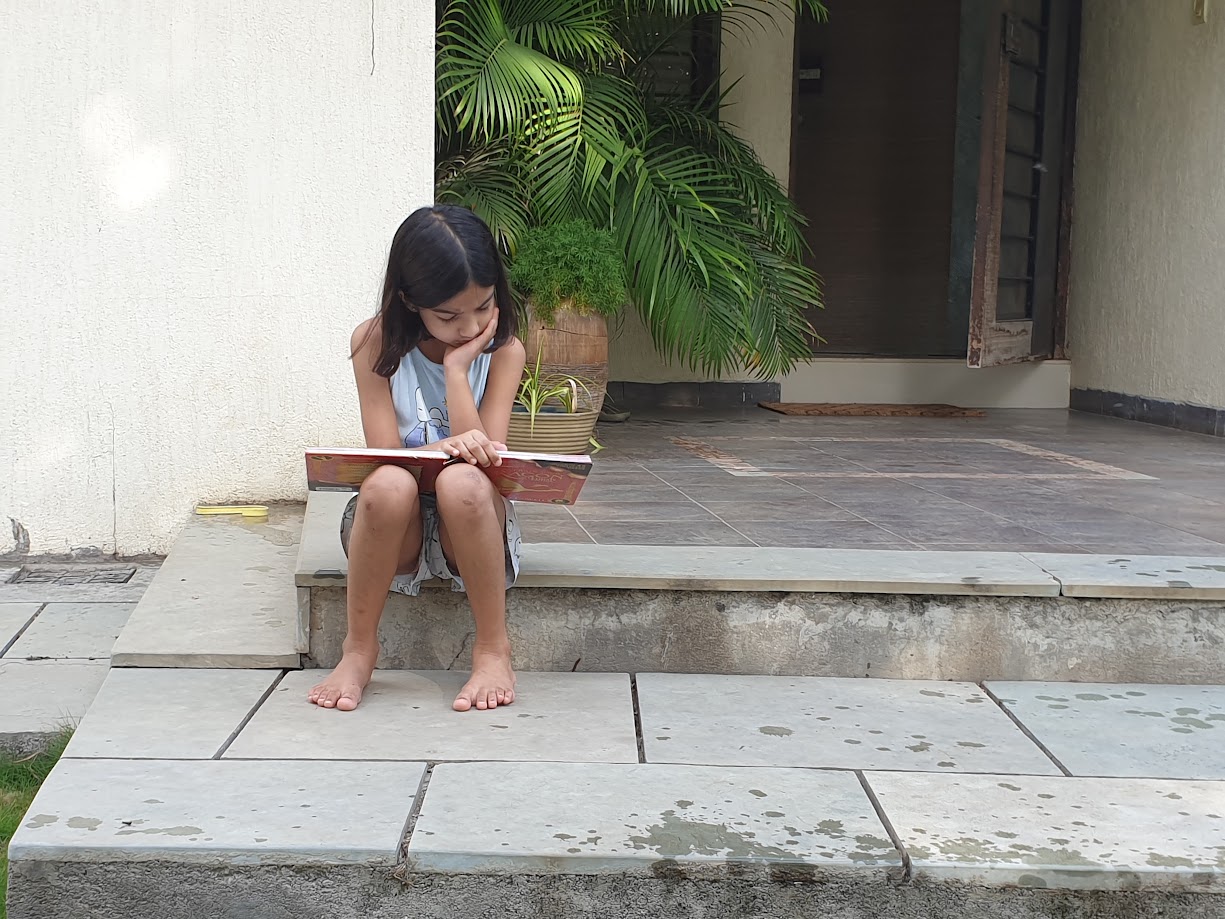
Barefoot on the porch steps, lost in a book. The world could wait.

Balancing a basket on her head with complete confidence. Sevagram 2024.
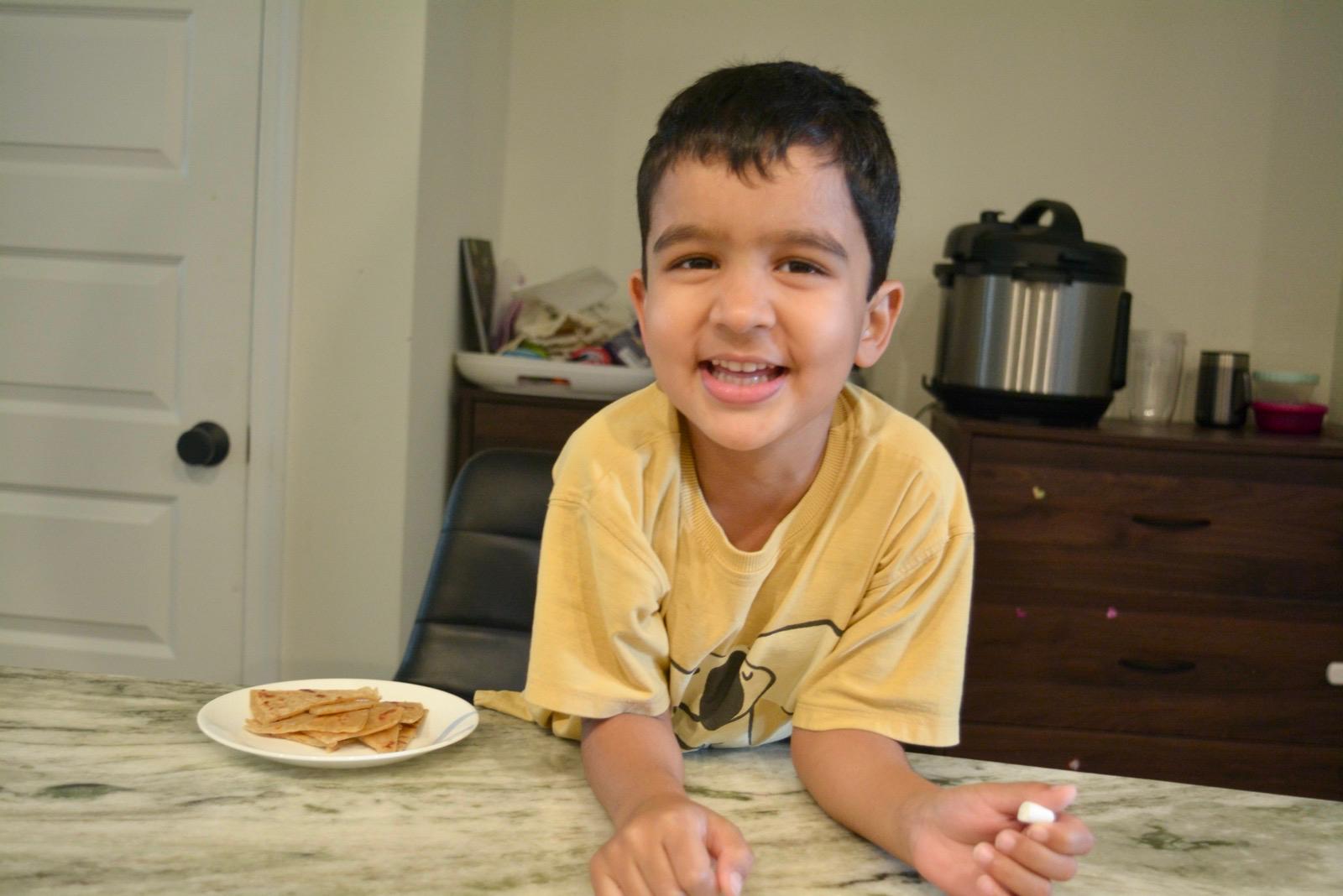
That grin says he has already eaten half the rotis on the plate.
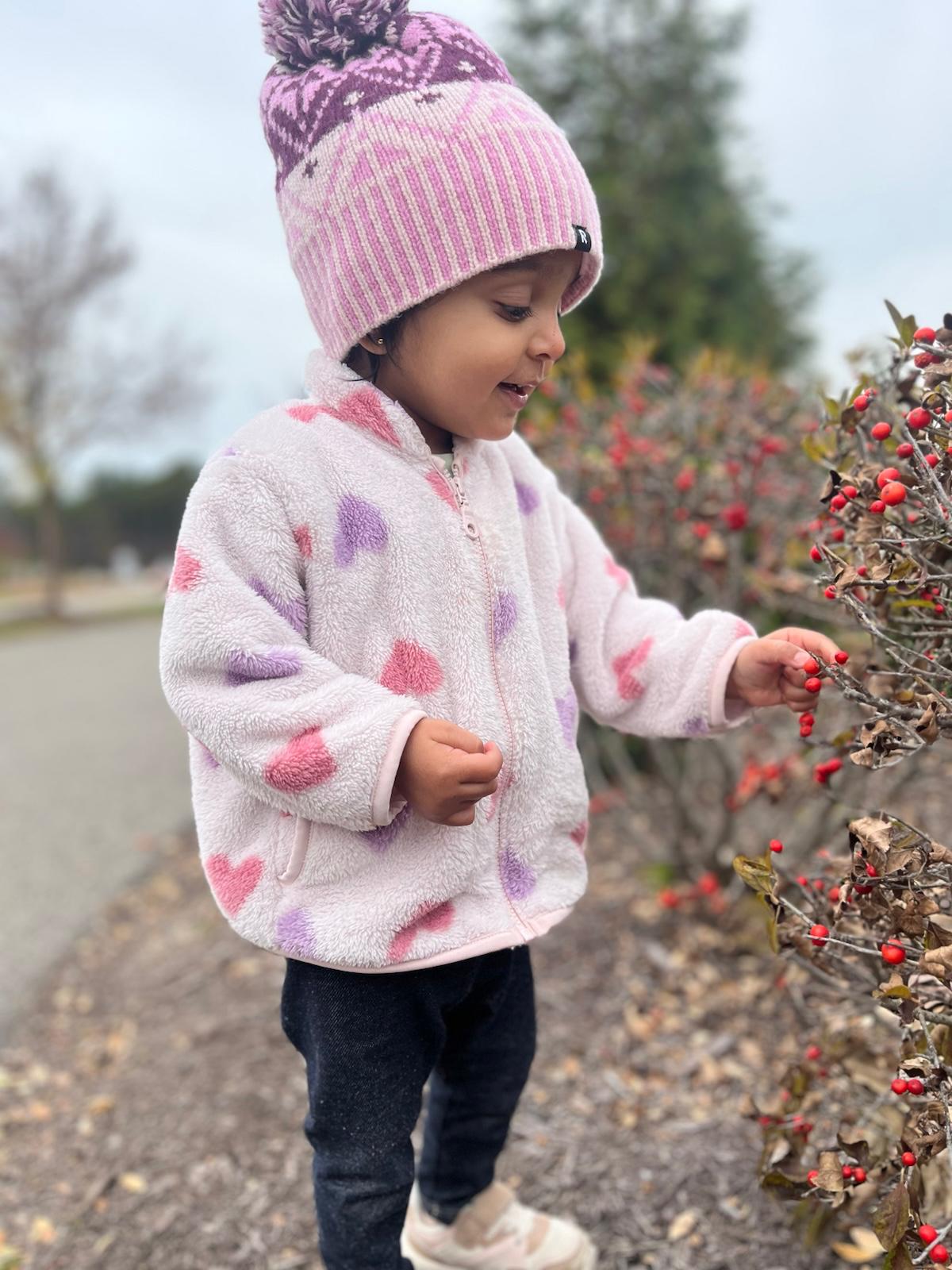
Discovering red berries on a cold morning. Everything is still new.
The Cycling Years
In 2016, I discovered long-distance cycling. Diti — then three — fell in love with it the way children fall in love with new worlds: completely, without reservation, and with no interest in going back.
Her father bought her a small bicycle. She was soon weaving through the staff quarters and gardens of Sevagram, ringing her bell with the authority of someone who had always owned the campus. By seven, she had become my riding partner.
During COVID, when schools shut and the world contracted to four walls, cycling became our shared escape. We would pedal to Pavnar — a seven-kilometre stretch that offered everything a cautious adult avoids: steep underpasses, sudden cattle, stray dogs appearing from nowhere like examiners in a viva. Diti tackled all of it with a fearlessness that still amazes me. Twice she cycled twenty kilometres without stopping. On those rides she asked for stories, as if the rhythm of pedalling opened the mind to listening. I told her about my childhood in Wardha, about Gandhi, about the history of the soil we were riding through. Those wind-swept mornings — the road empty, the air clean, the world not yet awake — remain among the happiest of my life.
The Adventurous Side
At ten, Diti picked up a new hobby: football — traditionally a boys’ game. She never played with girls her own age, choosing instead to play with boys three years older, who, according to her, were real competition. She was always drawn to sport. By all accounts, she has had two fractures, several wounds, and infinitely scraped and bleeding knees. These were medals to her — signs of pride, not misfortune.
A Child Who Lives in Books
If Diti’s legs belonged to wheels and footballs, her mind belonged to books.
She became a voracious reader with no patience for waiting. She began with The Jungle Book, moved to Enid Blyton, and by nine had worked through all seven Harry Potter books. She read at the dining table while her food went cold. She read in the car. When the house became too noisy — which, with Nivi around, was often — she discovered the one place nobody disturbs a child for long: the bathroom. Many chapters were finished there, in undisturbed peace.
I introduced her to Greek mythology, and she was immediately captivated by Odysseus. She could visualise Scylla and Charybdis with startling clarity, and she was genuinely outraged by the cruelty of Greek kings — as if she were reading the news, not a legend two thousand years old. Intrigued by Greek mythology, she moved on to Percy Jackson. Diti doesn’t merely read stories. She moves into them and takes up residence.
— ✦ —
Nivi — The Noisy Naturalist
Nivi arrived on 18 November 2016, and brought with her a different kind of attention. Where Diti loves books and sport, Nivi grew her passion for flowers and fruits. She tried to emulate her sister — as all younger siblings do — by completing an eight-kilometre cycle ride through Sevagram without complaint. And there she stopped, bored. She comes home from her school bus carrying flowers, twigs, and leaves, and noise. Lots and lots of noise.
She watches trees the way other children watch cartoons. She notices a new leaf, a fallen flower, a change in bird call. Walking near home with her Dadi Bhavana, she would pause at plants and ask questions that suggested she had been thinking about them long before she asked. She went to Anand Niketan, a Marathi-medium school in Sevagram. She struggled at first, as newcomers do. Then she did what Nivi typically does: she adjusted, and mastered the language. By her second year she spoke Marathi as if she had always belonged to this soil.
A year later, she moved to Lloyd’s Vidya Niketan — the school where Diti studies, and where her father Ashwini and her bua Amrita also went. The transition from Marathi to English was a torment on her tender heart, and she simply refused to go. It took tremendous patience, persistence, daily ingenuity, and the passage of time to finally help her feel at home. Now she enjoys her forty-five-minute bus rides as much as she loves her fruits and flowers.
She is also our resident food authority. A fruit vendor makes her eyes light up like a festival. She moves from strawberries to mangoes with the devotion of a connoisseur, and — true Sevagram child that she is — she loves baingan ka bharta with equal enthusiasm. No fruit is too seasonal, no vegetable too humble.
Uno, and the Art of Outwitting Dadi
Nivi’s favourite pastime is Uno — specifically, Uno with Bhavana, whom she outmanoeuvres with a sly intelligence (and no small amount of luck; Bhavana would let her cheat) that is both charming and mildly alarming. She has studied her opponent carefully. The mischievous grin when she plays a wild card tells you she has been planning it for several turns.
During the long, anxious days of the pandemic, their daily Uno sessions became a household ritual — part entertainment, part therapy, part proof that ordinary life was still possible. As the girls grew older, they began sleeping in our room. Their breathing, their clutter, their voices at odd hours — everything that might once have felt like disruption began to feel like warmth. They reminded us, in the middle of busy professional lives, that the most important titles we held were not Doctor or Professor. They were Dada and Dadi.
— ✦ —
Krit — The Firecracker From Chandigarh
Krit was born to Amrita in December 2020, and he arrived differently from his cousins — loudly, cheerfully, and with no interest in being overlooked.
He is rowdy, boisterous, and naughty, yet so utterly charming that you wouldn’t have the heart to tell him off — the kind of child who can turn a quiet house into a festival in under five minutes, then bring the house down with his tantrums. He started crèche at one year old at PGI Chandigarh, joining thirty other children, and by the summer of 2021 had already become a character. On a flight with Amrita, he entertained the entire cabin with his antics. The other passengers were, by all accounts, delighted.
When Krit visited us in Sevagram, the house entered a state of cheerful rebellion — studies kicked aside, responsibilities forgotten. Diti — observing him with the sharpness of an elder cousin who has paid close attention — offered what may be the most accurate description of him anyone has managed: “He’s funny, smart, determined, naughty, and happy. Like Nivi, he loves food. And like me, he opens any book he can find — even though he can’t read yet.” Three sentences. Entirely correct.
— ✦ —
Samanvi — Born on a Shared Birthday
The family grew again on 14 March 2024 — which is, by a beautiful coincidence, Diti’s birthday. Samanvi was born in Chandigarh. In a detail that felt almost arranged, she was delivered by Dr. Riti Narang — an MGIMS alumna, a Sevagram girl, and the daughter of our own faculty colleagues. The circle, as it sometimes does, closed neatly.
Bhavana reached Chandigarh within hours of the news. The baby, however, was in no hurry to receive a name. For six months she remained nameless while Amrita searched lists, school registers, and the internet with the seriousness of someone making a permanent and irreversible decision — which, of course, she was. Finally, six months later, she became Samanvi.
A true lily. She is quiet, observant, and content. She dotes on her brother, and there could not be two siblings more different, yet so fond of each other.
In December 2024, the story took a transcontinental turn. Amrita, Krit, and Samanvi moved to Richmond, Virginia, to join Sahaj. The first year in a new country is never gentle — viral infections, unfamiliar schools, new systems, and the particular loneliness of being far from a place where a doctor is always one phone call away. Bhavana travelled to Richmond twice over the past year, helping Amrita settle in.
Watching them build a life in America, I felt something I had not quite anticipated: pride and wistfulness in equal measure. The roots that had held us in Sevagram for four decades had, quietly, grown wings. The family that began in a small quarter in Wardha was now spread across two continents — still close, still familiar, just farther away than we had ever imagined they would go.