Whenever someone now praises the MGIMS library and calls it state-of-the-art, I nod politely. But in my mind I am standing beside the old Biochemistry laboratory, looking at a grey steel almirah that held thirty-five books and nothing else. Two wooden chairs. A fan that groaned more than it cooled. A slightly damp wall behind.
That cupboard was the library I first came to know. Perhaps it is because of that modest beginning that I have never been able to think of libraries as grand institutions. To me they have always felt like homes that slowly grow outward, room by room, as affection accumulates.
***
Where It Began
In 1969, when the college itself was young and uncertain, that single almirah was guarded with surprising seriousness by Mr NG Reddy, our first librarian, who catalogued each book as though it were precious. Deorao Taksande helped him quietly. Bhupendra Nath Das typed labels. A Nepali attendant dusted the shelves each morning.
None of them spoke about vision or facilities. They simply showed up and kept the place ready.
The library expanded almost by stealth — first upstairs, then to the hillock near Radiology — and by the time I arrived as a young man it had already become the intellectual centre of the campus. What I remember most from those years is not the size of the collection but the people who ran it. Taksande, Kusum Raole, Vijay Vairagade, Vaishali Ugale, and the attendants — Keshav Nidhekar, Mahajan, Keshav Chate, Sujata Sonar, Nanda Gosavi, Sarla Wankhede — knew every book by instinct. Mention a reference in passing and they would retrieve it before you had finished your sentence. Many had not studied beyond school, yet they possessed a librarian’s memory that no software could rival.
The library functioned not because of systems but because of care.
***
The Place That Adopted Me
When I joined MGIMS in 1982, the library quietly adopted me.
Between ward rounds and lectures, when the noise of the hospital grew too loud or a case troubled me, I would drift there without thinking. The moment I entered, the air felt different — cooler, slower, less demanding. I would pull out the BMJ or the New England Journal of Medicine and read with no plan at all. Sometimes an hour would pass before I realised I had missed lunch.
Over the years that reading room witnessed much of my intellectual growth. I prepared lectures there, marked papers there, wrote research proposals there, and occasionally sat doing nothing at all, simply enjoying the silence. The staff grew used to me. If I was not in the ward or at home, they assumed I would be at my usual desk.
I still think of two interns — Gopal Taori and Mufaddal Munim — who studied from morning till closing time, eating their tiffin at the table and leaving only when the lights were switched off. Today one works in Australia and the other in the UK. Whenever they visit, they talk not of degrees or designations but of that hall.
A library shapes people quietly. At the time I never imagined that one day I would be asked to rebuild it.
***
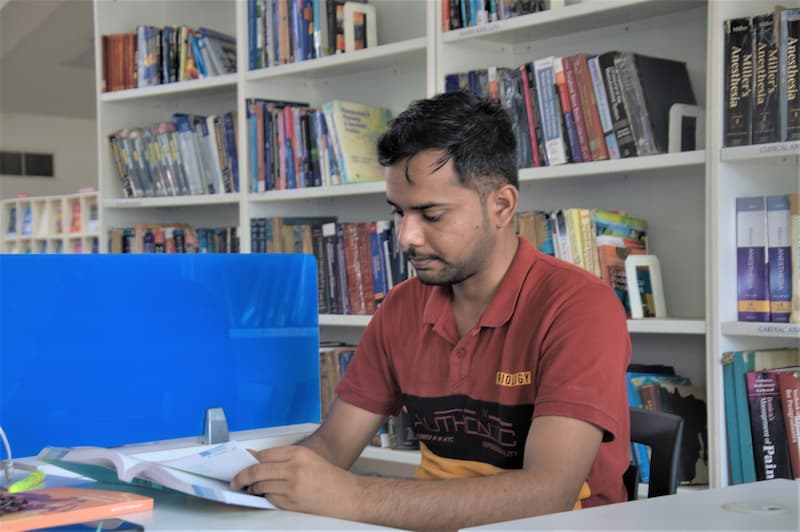
The Woman Who Said Yes
The turning point came not through any formal meeting but through a family conversation.
Shailaja Asawe used to visit Wardha to see her aunt, Suman Tai Bang, the Gandhian activist. She had an affectionate memory of being among the first to see Bhavana when she was born, and over the years she had become part of our extended circle — the kind of person who arrives at your home and immediately feels like she never left.
After her father, Shri Ramnarayan Manudhane, passed away, she and her siblings — Dr Nilima Raghavan, a Stanford paediatrician, and Avinash, a finance professional in New York — established the RG Manudhane Foundation for Excellence. During one of her visits I mentioned, almost in passing, that our library had outgrown itself and no longer met Medical Council requirements. I said it apologetically, the way one mentions a leaking roof to a guest.
She listened. She asked a few quiet questions. Then she said, in her direct, unhurried way: Let us build a proper one.
Soon afterwards she committed ₹2.5 crores.
I remember walking back to my office that afternoon with a curious weight in my chest. Excitement, certainly. But also the particular gravity of having been trusted. A donor’s faith is not money alone — it is belief. I knew that if we failed, we would not merely lose funds. We would betray a person who had chosen to believe in us.
***
The Architect Who Saw What Was Not There Yet
Shailaja introduced me to Sheetal Gandhi, a conservation architect from Pune. I had expected someone formal, someone who would arrive with a portfolio and a fee schedule. Instead, Sheetal arrived with questions.
She walked through the old Obstetrics and Gynaecology ward — the building that was to become the library — slowly, touching walls, measuring light, standing in doorways and looking at angles. She did not speak about what she would build. She spoke about what was already there, what could be kept, what the space wanted to become.
She knelt on the floor and began sketching. Not on paper — on the floor itself, with a chalk line, showing her team where the stacks might rise and where a reading table placed beside a particular window would catch the afternoon light. I watched her and understood, for the first time, that architecture at its best is not addition. It is listening.
***
[INSERT HERE: The image of Sheetal Gandhi and her team mapping the library on the floor — once you share it, I will provide full metadata. Insert after the paragraph ending “It is listening.” This is the image that shows the library being born — not from concrete and steel but from a chalk line on a floor.]
Three Years That Quietly Took Over My Life
If I am honest, those three years changed my daily life more than any administrative post ever did. I had imagined my role would be limited to supervision. Instead the library began to occupy my mind from morning till night.
My days settled into a rhythm I had never planned. Ward rounds at dawn, the hospital still half-asleep, antiseptic sharp in the corridors. By mid-morning I would be at a table with architects and contractors, arguing gently about square footage and shelf depths as though these measurements mattered as much as drug doses. After lunch I would slip a tape measure into my pocket and walk across to the stripped building — walls bare, floor dusty — and stand alone in the empty rooms trying to imagine where students might prefer to sit.
The rest of the day dissolved into small negotiations. I called the mason about unfinished plaster, the electrician about loose wiring, the plumber about leaking pipes, the interior designer about delayed furniture. Each conversation ended with the same quiet reminder: the deadline was not moving even if the work was. Once a week Harshal Deora would sit across from me with a notebook while I handed him a sheet of handwritten tasks. We would lean over it like schoolboys doing homework, deciding what could wait and what could not.
By evening the campus grew quieter. Before going home I often watered the young plants around the building, watching the dust settle on the leaves and the grass darken in the fading light. Those few minutes felt oddly calming — as though I were tending not just to the plants but to the project itself. After dinner, when the house finally slept, I returned to my desk to draft letters, adjust budgets, and run the numbers again, wondering whether we were stretching too far.
I had spent decades teaching medicine. Suddenly I was learning about ventilation ducts, electrical loads, fire exits, and toilet plumbing. Some days I felt faintly ridiculous — a physician masquerading as a civil engineer. Yet the work felt strangely satisfying, as though I were repaying an old debt to the place that had shaped me.
***
Watching a Ward Disappear
When demolition began, imagination was replaced by dust.
For weeks I watched labourers dismantle the labour room, the operating theatre, the faculty chambers, the wards — brick by brick. Walls that had witnessed births and emergencies crumbled into rubble. The pathologists downstairs protested about vibrations disturbing their microscopes. Harshal became Sheetal’s right hand on the ground, solving a hundred small crises every day.
I began visiting the site daily. I stood there in a helmet, shoes coated in white dust, watching the space empty out. There is something unsettling about seeing a familiar place erased — like watching an old memory fade in front of you.
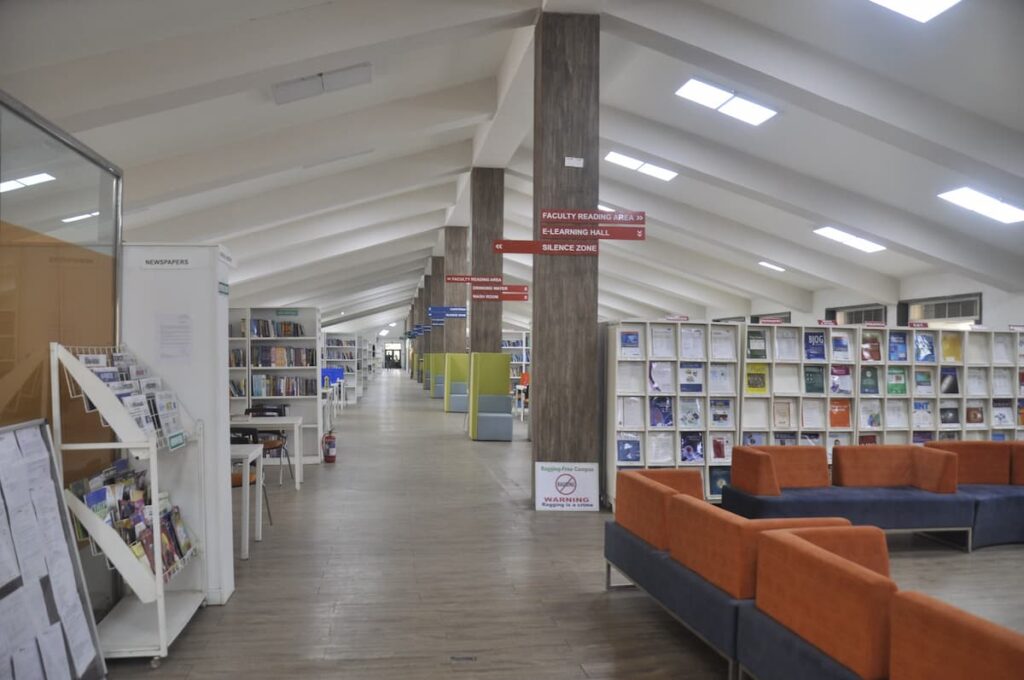
Yet slowly the new form emerged. Larger windows opened the walls to light. Cables snaked across ceilings. Shelves arrived. Desks were assembled. Godrej installed mobile compactors for decades of journals. Wi-Fi appeared at every table. A digital section took shape. When the first chair was placed and I sat on it alone in that half-finished hall, I felt a surge of emotion I had not anticipated. For the first time I could see the students who were not yet there.
***
[INSERT HERE: The exterior photograph of the library building — once you share it, I will provide full metadata. Insert after the paragraph ending “I could see the students who were not yet there.” The building from outside is the reveal — the reader has followed the construction from dust and chalk lines to this.]
***
A Collective Dream
Throughout this period I kept asking colleagues and alumni what they expected from the new library. Their responses formed a kind of chorus.
Smita Singh wrote about silent zones. MVR Reddy reminded us of MCI norms. Anshu described group-study cubicles from Maastricht. Subodh proposed an e-library. Aaditya Tarnekar pleaded that classic editions of Gray’s Anatomy not be discarded. Residents wanted 24-hour access. Others asked for daylight, greenery, lockers, charging points, coffee machines, digital subscriptions.
Reading those messages late at night, I understood something I had not quite admitted before. The library belonged not to any one person but to generations. I felt less like a builder and more like a caretaker entrusted with a shared memory.
***
The Difficult Inauguration
When the building was ready in 2018, I imagined the day would be one of uncomplicated joy.
Instead it became one of the more awkward days of my administrative life.
Shailaja wished that either her father’s memory be honoured or that her aunt, Suman Tai Bang — who had devoted her life to Wardha’s women and children and embodied the Gandhian spirit that MGIMS claimed to uphold — inaugurate the building. Both requests felt not merely reasonable but right.
Dhirubhai, as President of the institute, preferred to do the honours himself. He was not unkind — simply firm in the view that institutional protocol should prevail.
I found myself caught between two worlds: on one side the donor who had made the library possible, whom we regarded almost as family; on the other side the head of the institution to whom I reported. The conversations that followed were polite on the surface and heavy underneath. There is a particular exhaustion in being the person in the middle.
On the day the ribbon was cut and the photographs were taken, I smiled for the camera. But I carried a quiet embarrassment. The two women who had breathed life into this project — Shailaja, who had trusted us with her family’s money, and Sheetal, who had given the building its soul — were absent from the celebrations.
A library should stand for gratitude and shared effort. That day, it did not. It was a small human failing, perhaps inevitable in any institution. Yet it has stayed with me.
***
What Shailaja Left Behind
In May 2023, Shailaja Asawe passed away after a long illness.
That evening I walked through the Dr APJ Abdul Kalam Library alone. The lights were on. A few students sat studying quietly, entirely unaware that the woman who had funded the room they were sitting in had died that day. I stood near the entrance for a while and watched them — heads bent, pages turning, the soft hum of ceiling fans overhead.
Her gift had outlived all the awkwardness of inaugurations and protocols. Buildings endure longer than disagreements.
***
What the Library Is Now
Today, when I walk through the hall, I see students scattered across the floor, heads bent over books, screens glowing softly, conversations hushed to a murmur. The building no longer needs my supervision. It has acquired its own life.
Yet each corner carries a memory. Here we argued about shelf height. There we worried about wiring. On that staircase I once climbed twice a day checking progress.
Sometimes I settle into a chair with the latest BMJ or Lancet, intending to read. But my eyes drift — towards the staircase we widened, the windows we cut open for light, the corners where shelves now stand. I remember walking here with a tape measure. Arguing with contractors. Scribbling lists for Harshal. Facing formal protests from colleagues when the noise of demolition rattled their laboratories and patience alike.
The building returns to me not as architecture but as days and evenings, phone calls, dust, and small negotiations that seemed endless at the time.
And then the present reasserts itself. A student turns a page. A chair scrapes softly. The ceiling fans hum.
From that grey steel almirah of thirty-five books to this bright, spacious hall — the distance seems far greater than the years that separate them. All the library really has to do — what it has done since 1969 — is offer someone a chair, a book, and the unhurried time to think.
That, in the end, is enough.