The Moral Imperative
The Reluctant Convert: Bringing Comfort to Sevagram
Until 2016, I was a conventional physician. I believed our job began and ended with diagnosis, intervention, and cure. We were trained to view death as the enemy, a personal failure of science, a battle surrendered. When medicine reached its limits, we simply retreated behind our charts. In our intensive care units, we waged frantic, high-tech wars against dying, oblivious to the quiet indignity inflicted on the dying patient. We adjusted ventilators, corrected electrolytes, and checked arterial blood gases, but pain management—real, systematic, unvarnished comfort care—barely registered on morning rounds.
Then came a family nudge. Shailaja Manudhane, Bhavana’s aunt, arrived in Sevagram with her sister Nilima Ragavan, a neonatologist from Stanford. Both were vocal champions of palliative medicine. They urged me to visit Dr. P. K. Asokan at the Institute of Palliative Medicine (IPM) in Kozhikode. In 2016, out of curiosity more than conviction, I went.
That forty-eight-hour visit shattered my complacency. In the early 1990s, Kozhikode had sparked a quiet social revolution. Palliative care there was not a luxury locked behind corporate hospital doors; it belonged to the community. Dr. Asokan showed us how ordinary citizens—autorickshaw drivers, schoolteachers, homemakers, shopkeepers, and lawyers—formed an organic network of care. IPM gave them a brisk, day-and-a-half training in listening: how to sit beside an ailing neighbour, how to offer presence without clumsy pity, and how to avoid false cheer.
For the first time, I saw oral morphine used routinely, sensibly, and without fear. In our wards in central India, doctors treated morphine like contraband, terrified of addiction even in the terminally ill. In Kozhikode, a campus tea-stall vendor battling advanced cancer was taking hundreds of milligrams of oral morphine every day. He still brewed tea, bantered with students, and carried on with dignity.
I returned to Sevagram stirred, yet inertial routine is a powerful sedative. For two years, nothing moved.
By 2018, the unfinished business caught up with me. I wrote to Dr. M. R. Rajagopal, the anaesthesiologist widely regarded as the father of Indian palliative care. In 2003, after pioneering community care in northern Kerala, Rajagopal had established Pallium India in Thiruvananthapuram to take the movement national—campaigning relentlessly to amend India’s draconian narcotics laws so that doctors could actually prescribe pain relief. He agreed to let me attend his annual ten-day residential workshop. Dhirubhai Mehta, our institute’s president, backed me immediately, sanctioned my leave, and covered my travel.
At sixty-one, I was comfortably the oldest student in a room of fifteen trainees. For six hours a day, we unlearned the aggressive bravado of acute medicine. We studied the WHO analgesic ladder, the pharmacology of narcotics, and the fine art of breaking bad news. Above all, we learned to inquire about what clinicians routinely sweep under the rug: nausea, chronic breathlessness, insomnia, catastrophic fatigue, and existential dread.
The home visits around Thiruvananthapuram revealed another contrast. Kerala’s social fabric was unmistakable: patients lived in airy, tiled, pucca houses with refrigerators and sofas, cared for by visiting teams of nurses, social workers, and doctors. I knew then that copying Kerala wholesale in Vidarbha would be foolish. In Sevagram, our patients were impoverished cotton farmers and landless labourers. If palliative care was to take root in our soil, it had to speak directly to rural destitution.
Unlearning Medicine in March
In March 2019, we brought the movement directly to Sevagram. MGIMS partnered with the Trivandrum Institute of Palliative Sciences (TIPS), an arm of Pallium India, to conduct a ten-day foundation course right in our Medicine seminar room. Twenty participants signed up—a diverse, cross-disciplinary cohort that included Vishakha Jain and Sumedh Jajoo from Medicine, Neha Gangane from Obstetrics and Gynaecology, Megha Kawale from ENT, Sourav Goswami from Community Medicine, Kalyani Joshi from Dental Surgery, Ruchi Kothari from Physiology, Anuradha Khandekar from Alternative Medicine, alongside dedicated staff nurses like Suma Antony and Sarla Gulhane.
On the opening evening, March 4, we packed the Anatomy Lecture Hall for Hippocratic: 18 Experiments in Gently Shaking the World. The documentary traces Dr. Rajagopal’s crusade, framing his mission through eighteen experiments drawn from the life of Mahatma Gandhi. Faculty, resident doctors, nurses, medical students, and local journalists sat side by side in the dim auditorium. Seeing Rajagopal’s stubborn, quiet compassion on screen—rooted in the very principles of ethical service and non-violence conceived here on our soil—dissolved our faculty’s cynicism far more effectively than any clinical lecture could.
Over the next ten days, a remarkable faculty guided our unlearning. Ms. Gilly Burn, a British nurse whose evangelical passion for Indian palliative care is legendary, hammered home the essentials: communication, how to break shattering news with gentle honesty, and why pain relief must be woven into the undergraduate medical curriculum. Dr. Abhijeet Dam came down from KOSHISH, his rural hospice in Jharkhand, to demystify symptom control, terminal restlessness, and delirium. Alice Stella, an experienced nurse from TIPS, conducted practical drills in bedsore staging, complex wound dressings, and psychosocial assessment. We were joined by Jimmy Rana, the managing director of Dinshaw’s and a pioneer of hospice philanthropy in Nagpur, who reminded us that sustained palliative care survives only when healthcare professionals join hands with civil society.
The training refused to stay inside lecture halls. Our participants, joined by MGIMS medical social workers, fanned out into surrounding villages for home visits. They sat by cancer patients in mud-and-thatch homes, listening to the unspoken despair of impoverished families and practicing home-based comfort care where it mattered most.
Dr. Rajagopal himself addressed a joint session at the Academy of Medical Sciences. In his quiet, measured baritone, the Padma Shri awardee reminded the gathering that medicine cannot remain preoccupied solely with physical signs: “Medical care is not merely physical relief; it must embrace the emotional, social, and spiritual suffering of both patient and family.” He pledged his full support to help Sevagram build its own unit, while nudging us to become vocal advocates for legislative reform and equitable pain management.
The workshop transformed our campus vocabulary. Vishakha Jain, who was instrumental in orchestrating the logistical details, noted how the sessions laid bare the agony and silent anger bred by chronic illness. Mona Rai, our palliative physician, spoke of restoring dignity and self-respect to dying patients and their kin. For my part, as Medical Superintendent and course secretary, I could see the institutional mindset pivoting. Closing the valedictory session, I announced what had previously been only a quiet whisper: Kasturba Hospital was now ready to treat the whole person, not merely the disease, and plans were officially afoot to build a dedicated 30-bed Palliative Care Centre on our campus.
The Architects of Compassion
By late 2018, I had just finished the monumental task of constructing our new institute library. I was looking forward to an administrative breather. But destiny, engineered by our management, had other plans: I was asked to build a dedicated Palliative Care Centre.
My years as Medical Superintendent had taught me a hard truth: there is a profound difference between extending a life and merely prolonging an agonizing death. As I walked the wards and saw patients with end-stage cancer tethered to noisy monitors, their eyes a well of pain and abandonment, any lingering hesitation vanished. This was no longer just another civil construction assignment; it was a moral imperative.
A dream of this scale requires more than empathy; it demands capital. We found our patron in Mr. Ramu S. Deora, a Mumbai industrialist who stepped forward to donate ₹5 crore in memory of his father, Mr. Sitaram Deora. The catalyst was our trustee, Ms. Sarla Parekh. A force of nature with an abiding loyalty to Sevagram, she had previously funded our Medicine Department building. Her moral authority was the bridge that brought Mr. Deora to our cause.
With funding secured, I dove into the drawings. We collaborated with our architect, Mr. Ramteke, but as always in Sevagram, execution rested on our reliable in-house engineering team: Mr. Harshal Deoda, with whom I had shared a long building partnership across the campus, and our contractor, Mr. K. P. Bardhiya.
We broke ground in June 2019. For months, the rhythmic hum of concrete mixers set the campus cadence. Then, in March 2020, the country slammed into the COVID-19 lockdown. The bare concrete skeleton stood naked against the scorching summer sky, an eerie monument to global paralysis.
When work cautiously resumed in May 2020 under strict distancing protocols, the lockdown isolation had altered my thinking. The solitude of the pandemic made me acutely aware of how terrifyingly lonely chronic illness can be. I began to worry: would patients feel exiled in this stand-alone sanctuary, detached from the bustling life of the main hospital?
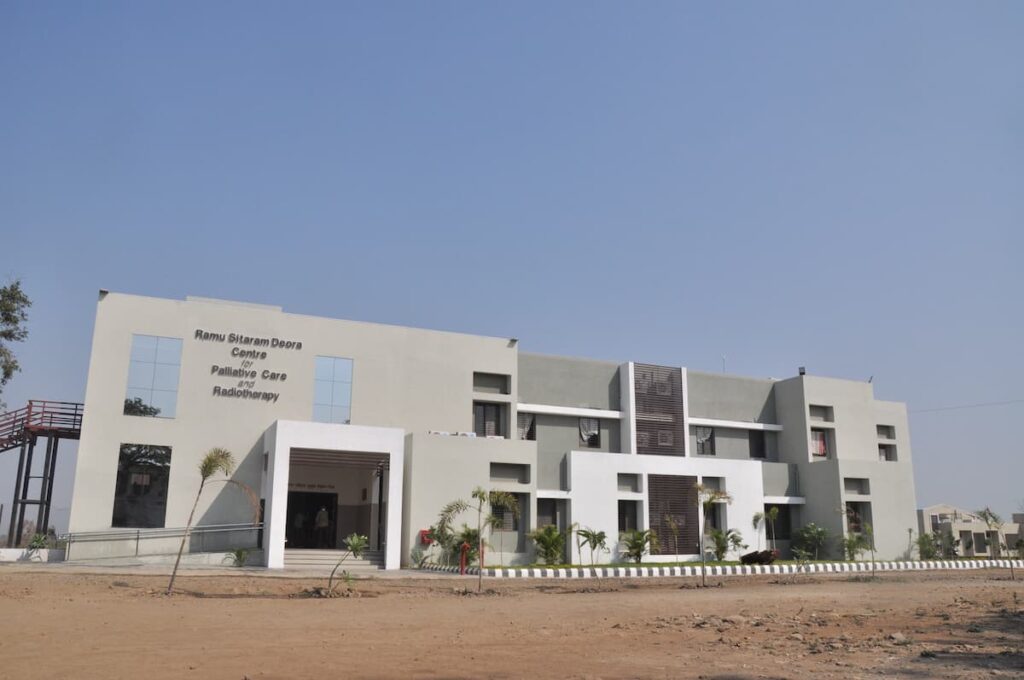
That anxiety triggered an expansion. Cancer care cannot operate in isolated silos; palliation and oncology must shake hands. I decided to double the blueprint, adding an upper floor dedicated to Radiation Oncology. Under one roof, patients would find both definitive tumour therapy and compassionate symptom control. I also insisted on six private rooms alongside the general wards. In a Gandhian institution, the poor rightly come first, but dignity occasionally asks for quiet privacy, and offering comfort across every financial stratum was entirely consistent with our ethos.
Designing for the Soul
I was stubborn about one detail: this building must neither look nor smell like a conventional hospital.
We chose a warm rose gold palette for the interiors. It was a deliberate antidote to the sterile, intimidating greens and whites of institutional medicine. We matched the walls, window curtains, and even the foldable attendant couches to this tone. Behind the main registration desk, we commissioned a mural: a young doctor’s hand gently cradling an aged, weathered hand. It served as a silent, visible promise of presence.
Outside, the surrounding red mud transformed. Harshal Deoda joined hands with our head gardener to sculpt a stepped terrace garden. In a stroke of quintessential Sevagram frugality, our gardener salvaged discarded ceramic surgical washbasins from old hospital renovations, turned them into earthen planters, and filled them with orange and yellow blossoms. Soon, patients stepping into the courtyard were greeted not by bleak concrete, but by the fragrance of frangipani, royal palms, oleander, and flowering bougainvillea.
The construction had its share of thorns. We locked horns with municipal town planners over fire norms, eventually designing a wide external ramp and emergency staircase to wheel bedridden patients out safely.
There was also a delicate, diplomatic skirmish with our donor. In his pride, Mr. Deora wanted his family name inscribed across all four facades. I had to sit him down and gently explain that such ostentation would jar with the austere Gandhian aesthetic of Sevagram. He saw reason, and we settled amicably on an understated plaque mounted on the front porch.
Yet the toughest resistance came from my own tribe. Physicians are indoctrinated to battle until the final flatline; to many colleagues, referring a patient to palliative care looked suspiciously like surrender. I spent hours pleading with clinicians to move terminally ill patients out of the cold, fluorescent glare of the ICU into the dignity of the new wing. We piped in soft instrumental music and created a quiet meditation room where families could sit with grief without being shooed away by orderlies.
Opening the Sanctuary
On December 21, 2020, the building opened its doors. To anchor its academic roots, I asked my postgraduates, Navaneeth and Fannie, to write their MD theses on the hidden burdens borne by palliative caregivers. Mentored by Dr. Preetam Salunkhe, an assistant professor of medicine who took clinical charge of the unit, they learned early that clinical medicine is as much about patient listening as it is about writing prescriptions.
That morning, I sent an email to the entire medical faculty:
The wards filled quickly. Clinical Unit 4 in the Department of Medicine took responsibility for inpatient care, and we broadened the remit well beyond oncology. Palliative medicine in rural central India had to reflect the realities of our emergency triage.
Alongside advanced malignancies, our beds were soon occupied by elderly stroke patients with dense hemiplegia, decompensated cirrhotic farmers, chronic kidney disease patients who could no longer afford the physical toll of maintenance dialysis, severe head injuries from state highway crashes, children with painful sickle-cell vaso-occlusive crises, and the tragic fallout of agricultural organophosphate poisonings and hemotoxic snakebites.
After four decades in white coats, we finally stopped measuring our worth solely by the lives we pulled back from the edge of the grave. We learned the quieter, harder, and far more honest art of standing beside those we could not save—ensuring they were warm, free of pain, and never alone.
Preetam was one of our own—an MGIMS alumna from the batch of 2008 who stayed on to complete her MD in Medicine. When she joined Unit 4, she threw herself into palliative care with genuine zeal. But ambition has its own restless gravitational pull. She left us first for JNMC Sawangi for a year, dipped her toes into private practice, and eventually drifted back to Sevagram for a second, two-year stint before heading off to AIIMS Nagpur. Her departure left me without a dedicated faculty colleague to share the load, but with our postgraduates and a loyal band of palliative care nurses, we carried on regardless. Chronic staff shortages meant our dedicated outpatient clinic remained stillborn on paper. Now, the landscape has changed. Having retired in August 2026, the administrative headaches and daily triage of running an active medical unit are behind me. Unburdened by rotas and routine chores, I can finally return to where my heart settled a decade ago—ready to get that outpatient clinic off the ground and give comfort care the quiet, undivided devotion it always deserved.