Some education happens in lecture halls, under fluorescent lights, in front of PowerPoint slides. Some happens in rooms where the chairs are arranged in a circle and nobody is quite sure, when the day begins, where the conversation will go. The three workshops I write about here belong to the second kind. They did not give me a certificate. They gave me something harder to name — a way of seeing what was already in front of me, but which I had not, until then, truly looked at.
***
Nagpur, September 2001: The Weekend Nobody Expected to Work
The Academy of Medical Sciences in Nagpur had organised a workshop on medical ethics. When it was first announced, the response was indifferent, sometimes openly hostile. Why would a doctor leave his practice on a weekend for a subject with no CPD credits, no drug company dinner, no excursion? One colleague said plainly that ethicists were armchair critics — too removed from the real world to understand why kickbacks existed. Another wondered if the Academy had made a mistake.
The organisers were not sure themselves. They had promised simple vegetarian food, no alcohol, a pen and a writing pad. Delegates would pay their own fees; no sponsor would enter the room. On the eve of the workshop, some thought of planting questions in the audience to prevent an embarrassing silence.
They need not have worried.
Seventy-four doctors enrolled. Fifty-eight came. A drug company had organised an excursion for doctors and their families on the same day; forty-four doctors still chose to stay until the end. When a speaker finished talking, hands went up before he had sat down. Arguments broke out — heated, genuine arguments — about whether patients tested for HIV should be informed, whether their spouses had the right to know, whether bad news belonged to the patient alone or to the family who would carry it. These were not abstract questions. Every man and woman in the room had faced them in their own consulting rooms and carried them home at night.
I watched doctors who had never spoken on such matters in a professional setting find that they had opinions — strong ones. I watched a psychiatrist and a surgeon discover, with some surprise, that they disagreed entirely on informed consent and agreed entirely on the ethics of dying. Something was happening in that room that scientific conferences in Nagpur had rarely witnessed: people were being honest.
One delegate said at the end, almost to himself, that he had understood for the first time what Mother Teresa had meant when she said that medicine is a vocation. Not a profession, not a business. A vocation.
I have not forgotten that sentence. It arrived quietly and stayed.
***
Nagpur, December 2017: Learning to Name What We Already Knew
Sixteen years later, the Academy returned to ethics — this time in a residential setting, two days at the Surhabardi estate outside Nagpur, forty doctors, and a faculty that included some of the most serious thinkers in Indian medical ethics: Amar Jesani, Sanjay Nagral, Arun Gadre, Sunita Bandewar, Veena Johari, Arun Mitra.
What struck me, sitting in that room in December, was not the novelty of the questions but the rigour brought to questions I had always assumed I understood. Conflict of interest, for instance — a phrase I had heard many times — was not simply about taking gifts from pharmaceutical companies. It was a structural condition, embedded in the way medicine is organised and paid for, the way hospitals are run, the way private practice creates incentives that pull silently against the patient’s interest. Gadre and Nagral did not sermonise. They told stories, some of them uncomfortable, drawn from their own practice. They showed, without saying it directly, that even good doctors operate inside systems that make ethics difficult, and that acknowledging this is not a confession of weakness but the beginning of clear thinking.
Jesani opened the workshop with a question that has not left me: what does it mean to be good, and is being good the same as doing good? A doctor can perform every correct procedure and remain indifferent to the person on the table. A doctor can feel great compassion and fail the patient entirely. Ethics is not located in feeling or in procedure alone. It lives in the space between them, in the quality of attention one brings to each encounter.
The session on end-of-life care, which I shared with Sunita Bandewar, made plain something I had long sensed but not articulated: that dying patients are not failed patients. That the refusal to acknowledge dying — the pivot to one more scan, one more line of treatment — is sometimes not hope but its absence, dressed in the language of medicine. To sit with a patient who is dying and tell the truth without abandoning them is, in its own way, the hardest thing a doctor does.
Sanjay Nagral had a flight to catch. I dropped him at the Nagpur airport and turned the car towards Sevagram. The 75 kilometres home felt longer than they were.
***
Sevagram, March 2019: The Faces Behind the Numbers
The training programme in palliative care that the Department of Medicine at MGIMS hosted in March 2019 was different again. Dr MR Rajagopal came from Trivandrum. Gilly Burn, who has spent a lifetime working in palliative care, came from the United Kingdom. Abhijit Dam came from a hospice in rural Jharkhand. Jimmy Rana, who had built the first palliative care centre in Nagpur from his own resources, came to speak not as a clinician but as a man who had simply seen suffering and decided he could not look away.
The ten days began with a film about Rajagopal’s own life — his decades of work to make morphine available to dying patients in India, his encounters with bureaucracy, indifference, and occasional hostility from within the medical establishment. The film was not comfortable viewing. It was a record of how thoroughly the system can fail a patient in pain, and of what one person, over a lifetime, can change.
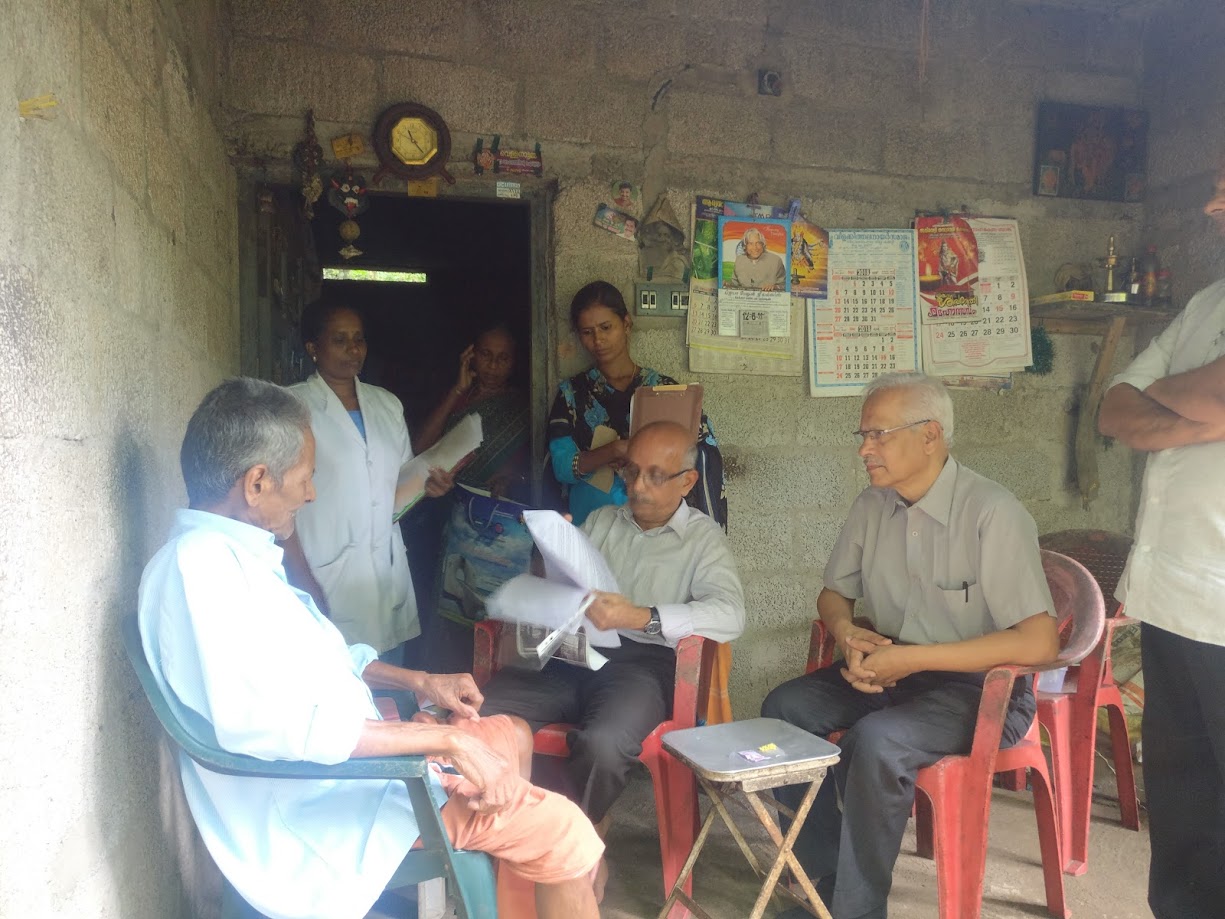
Lessons in compassion: Learning community palliative care with Dr. M.R. Rajagopal, Thiruvananthapuram, 2018.
What the workshop did, more than any lecture could, was put us in the homes of patients. Social workers had identified people living with cancer in the villages around Sevagram, and participants — nurses, physicians, a gynaecologist, an anaesthesiologist, a dental surgeon — visited them under faculty supervision. These were not ward rounds. There were no files, no monitors, no trolleys. There were families managing on small incomes, caring for someone who could not be cured, trying to understand why they still had pain when they had been given medicines for it. There were children who had not been told the truth about their parent’s illness because the family had decided, unanimously, that the truth was too dangerous.
In those homes, the gap between what medicine offers and what patients need became very clear. It was not a gap that technology could close.
Gilly Burn spent a morning on communication — not the communication of information, which doctors are trained in, but the communication of presence, which most of us are not. She spoke slowly, and chose her words carefully, and the room was quiet in a way it had not been during any other session. What she described was not a skill so much as a discipline: the discipline of staying in the room with someone who is frightened, of not reaching for reassurance when what the patient needs is simply to be heard.
I have tried to practise this since. I do not always manage it. But I know now when I am failing, which is more than I knew before.
***
Three workshops. Twenty years. The questions they raised — about honesty, about power, about what we owe the people who come to us in pain — do not have final answers. They have only the practice of returning to them, in each new room, with each new patient, and trying to do a little better than the last time.
That, I think, is what they were really teaching.