She collapsed on an unremarkable evening, in front of her family, for no reason anyone could name.
Hours earlier she had been a twenty-four-year-old software engineer going through an entirely uneventful day — awake, dressed, fed, coding at her laptop through the afternoon, out for a brisk walk with friends by evening. Then, without warning, she went down. When she came to, moments later, her legs were on fire.
Not the ache of a cramp or a sprain. This was electricity — a searing, cutting pain, as though someone had poured boiling water over her skin. Even her clothes, brushing against her legs, were unbearable.
“What’s happening to me, Aai?” she cried, clutching her mother’s saree.
Her mother had no answer. A few hours ago her daughter had been laughing. Now she was rocking her legs from side to side, begging for cold water to douse the burning. “Were you bitten by a scorpion? A snake?” her mother asked, grasping at anything. “We’re on the third floor,” her brother, a twelfth-grader, pointed out. “How would a snake get up here?”
It was the second week of November 2025. On the television in the next room, news channels were shouting about the Bihar election results. Nobody in that house was listening.
Her mother fished out a strip of Crocin and Brufen from the nightstand drawer. The pain did not move. A neighbourhood doctor came, gave her a Diclofenac injection, a shot of Vitamin B-complex, a mild sedative, and a promise that the night would settle things. It didn’t. She could not eat. She could not sleep. Her heart hammered past 110 beats a minute even at rest, even in bed. Her mother sat by her through the night; her father wore a groove in the floor outside.
What followed was two months that no family should have to live through.
A neurologist in Nagpur examined her thoroughly — reflexes, muscle strength, nerve conduction — and found nothing wrong. Her blood work was normal. Her spinal MRI was clean. A second neurologist tried an electromyogram. Also normal. Diabetes, thyroid, autoimmune markers, celiac disease, copper deficiency, rare infections — one by one, the tests came back blank, and one by one, the specialists ran out of road. She lost fifteen kilograms. She stopped being able to walk without wincing, because the soles of her feet, touching the floor, felt like hot coals.
Eventually the first neurologist told the family, plainly, that he had nothing left to offer. “She may simply have to live with this,” he said. “For how long, I do not know.”
That is the sentence that brought her to Sevagram, where a relative worked as a surgeon at Kasturba Hospital. He admitted her, ordered a fresh round of scans, and, almost as an afterthought amid all that testing, asked for a check of her sympathetic skin response — a measure of the nerves too fine for ordinary tests to catch, the ones that govern sweating, blood vessel tone, heart rate. It came back absent in all four limbs.
Her large nerves — the ones that move a leg or register a pinprick — were intact. It was the small fibres that had gone dark.
“Could you look at her, Dr. Kalantri?” the surgeon asked one morning. I said I would.
The walk to the surgical ward is a long one, a separate building from the Department of Medicine. I found a young woman who had been taken apart by four months of pain and uncertainty — pulse racing at 112, voice breaking mid-sentence, eyes wet.
I asked her mother and brother to wait outside, pulled a chair to her bedside, and did the one thing that costs a hospital nothing: I asked her to tell me everything, in her own words, from the beginning. How it started. What made it worse. What eased it. Whether she could still control her bladder. Whether anyone in the family had ever had anything like this. I did not interrupt.
She had been examined by some of the best specialists in two cities. Nobody, it seemed, had simply let her talk. Within minutes her account grew steady and clear, the way a story does when someone is finally listening to all of it.
I went through her file afterward — the scans, the blood reports, the discharge summaries stacked inches thick — and a shape began to emerge that the tests, taken one at a time, had missed: an acute small fibre neuropathy, with the autonomic nervous system caught in the blaze. Small nerve fibres carry pain and temperature and keep the heart rate and blood vessels in check; when they inflame suddenly, they produce exactly what she had — burning, electric shocks, a racing pulse, skin so sensitive that a bedsheet feels like sandpaper — while the standard nerve tests, built to catch larger nerve damage, see nothing at all.
Back at my desk, I did what any physician should do and too few find the time for: I opened UpToDate and PubMed and read. The literature was fairly clear on cases like hers — a five-day course of intravenous immunoglobulin, high-dose steroids to calm the immune system, medication to quiet the nerves, and something for the sleeplessness. I wrote the orders and walked back to tell her it was treatable.
Then I did something I don’t remember doing before or since. I took out the cheap blue ballpoint pen I carry — the ten-rupee kind, because I am forever losing pens — and wrote a date across the top of her case sheet, and turned it to face her.
15 March 2026.
“What’s that for?” she asked.
“That’s when you’ll be back on your feet,” I said. “Walking. Cycling. Living, without this pain.”
She looked at me the way you might look at someone who has just said something reckless. “Doctor, the biggest names in Nagpur saw me. My files went to Mumbai. Nobody could even tell me what this was. And you’re giving me a date?”
I don’t know, looking back, where the certainty in that moment came from — perhaps only the relief of finally having a name for what was wrong, and the arrogance that relief can bring. I told her I trusted the diagnosis, and left the room hoping I was right.
We began the five-day course. Day by day, something in her steadied. Her pulse settled into a normal rhythm. The burning cooled. She slept. Before she was discharged, she took a few careful, unaided steps around the room — no tears this time. “Remember the date,” I told her as she left. “March 15th.”
Two months later, on a busy Saturday evening in the OPD, I saw her walking toward my desk with her mother, upright, unhurried, smiling.
It was only then that I learned the rest of it. In the weeks before Sevagram, with every scan coming back clean, some of her doctors had begun to wonder if the problem was in her mind rather than her nerves. She had been given antipsychotics. Antidepressants.
“You were the only one,” she told me, “who looked at me and said this wasn’t in my head — that my nerves were inflamed and my pain was real. Everyone else reached for a psychiatric label the moment their machines came up empty.”
I checked her over, adjusted her medicines, and asked her to come back in a few months.
She walked into my clinic again this July, and I almost didn’t know her. The fifteen kilograms were back. Her colour was back. Her eyes had that light in them that illness takes away and recovery slowly returns.
“How are you feeling?” I asked.
“On a scale of one to ten? A hundred,” she laughed. “I swim now. I cycle. I drove myself from Nagpur to Wardha today.”
A few residents were sitting in with me that afternoon, and I found myself telling them what this young woman’s case had taught me — not as a lesson I had mastered, but as one I am still learning, case after case, and will likely go on learning until the day I retire.
“We surround ourselves with tests and scans and algorithms,” I said, “and it is easy to lose the patient somewhere in that forest of data. But the most powerful instrument in this profession costs nothing, requires no machine, and hurts no one. It is the plain willingness to sit down and listen.”
“And then?” one of them asked.
“And then you go back to your desk, open a book or a journal, and admit how much you still don’t know. Medicine changes every day. Somewhere in that day’s reading is very likely the answer you are looking for — if you’re willing to go and find it.”
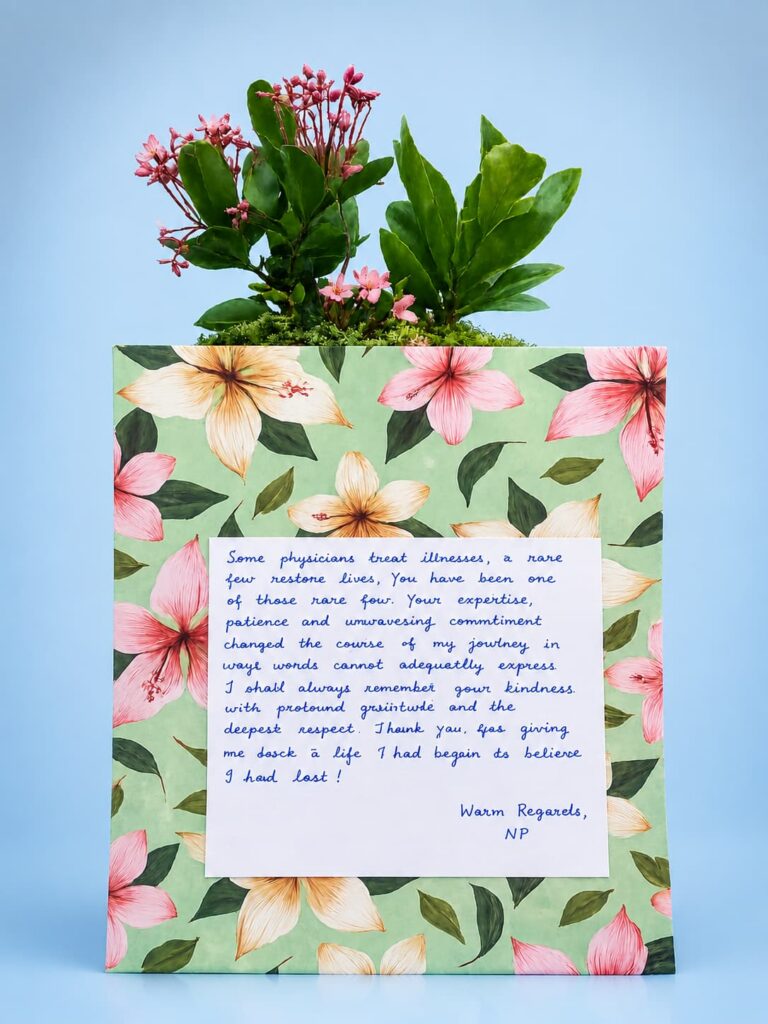
Before she left, she and her mother handed me a small potted sapling and a handwritten card. It sits on my desk still, a little greener each week.
I think back, sometimes, to that cold November night and a date written in blue ink on a case sheet — a small, ordinary pen doing something it had no business doing. The medicine cured her. But it was the listening that opened the door the medicine walked through.